The other day an Ethiopian friend told me about a movement that was partly Protestant and partly Orthodox called "ortho-pente". I cannot find much on it, but I did find this. There is alot going on in Ethiopia that should be paid attention to by people who are aware of the need for Orthodox and Evangelicals to work together.
http://www.ethiocross.com/
Saturday, December 10, 2011


Thursday, December 1, 2011
Christian Solidarity Worldwide conference in London
the respected human rights group Christian Solidarity Worldwide (CSW) put on a conference last weekend in the Westminster section of London. CSW is a class outfit that does work that compliments other similar groups such as Barnabas Fund and Open Doors. CSW's work has a legal and policy edge to it that distinguishes it from the other groups, at least in my take. How does what I saw there relate to my current blog theme?
I was so please at the way that the Evangelicals related to the Coptic bishop. Bishop Angelos of the UK Coptic Orthodox Church gave a very impressive talk in which he urged us not to feel sorry for Egyptian Christians but to pray for them and for all of Egypt. Having just finished Brother Andrew's book Secret Believers: What Happens when Muslims come to Christ in Muslim Countries, which also shows cooperation between Evangelicals and the Coptic Orthodox church (I am quite sure the main country is Egypt though it is not named as such) I am sure this is one the ways forward in this situation.
Tina Ramirez, who works in government in the US and has studied the issue of religious freedom at the academic and policy level and knows it in depth, spoke on the alarming trends of inceasing persecution of Christians in the world in the last 20 years. She, as well as an MP named Burt (whose first name I lazily can't recall without looking for it on the net) talked about how the case must be made to leaders in Muslim majority countries that respecting the rights of Christians is improvement in their society overall. There are statistical studies that have been done showing that levels of relgiously motivated violence against minorities is tied statistically to political instability. I wish I knew more about this, but someone named Brian Grim, whose name came up in Ramirez' talk, has done work on this and is part of a very intelligent discussion on these issues.
There was a church leader from Iran, whose name does not appear on the CSW website, I suppose for his protection, said that there a big changes taking place in Iran. The most conservative estimates say that there are several hundred thousand Christian converts in the country just in the last few years, and the more liberal estimates are one million. The speaker works for Elam ministries, who do very good work. He also mentioned the issue of Persian martyrs in the Iranian church before the coming of Islam. I am writing my dissertatin on the Church of the East and its formation in the Sasanian Persian empire, and this issue of maryrs is very close to my heart. If eastern orthodox and Roman catholics and the other liturgical tradtions believe in the power of martyrs, and the importance of martyrs, why do we not just stand up and say that the 50 people killed in Iraq last October and the 100 people who've been killed in Egypt this year for their faith are martyrs?
Tertullian of Carthage, one of my heroes and whom I wrote my MA thesis about some years back, wrote that "the blood of the martyrs is the seed of the church." why don't we start thinking about what this might actually mean?
I was so please at the way that the Evangelicals related to the Coptic bishop. Bishop Angelos of the UK Coptic Orthodox Church gave a very impressive talk in which he urged us not to feel sorry for Egyptian Christians but to pray for them and for all of Egypt. Having just finished Brother Andrew's book Secret Believers: What Happens when Muslims come to Christ in Muslim Countries, which also shows cooperation between Evangelicals and the Coptic Orthodox church (I am quite sure the main country is Egypt though it is not named as such) I am sure this is one the ways forward in this situation.
Tina Ramirez, who works in government in the US and has studied the issue of religious freedom at the academic and policy level and knows it in depth, spoke on the alarming trends of inceasing persecution of Christians in the world in the last 20 years. She, as well as an MP named Burt (whose first name I lazily can't recall without looking for it on the net) talked about how the case must be made to leaders in Muslim majority countries that respecting the rights of Christians is improvement in their society overall. There are statistical studies that have been done showing that levels of relgiously motivated violence against minorities is tied statistically to political instability. I wish I knew more about this, but someone named Brian Grim, whose name came up in Ramirez' talk, has done work on this and is part of a very intelligent discussion on these issues.
There was a church leader from Iran, whose name does not appear on the CSW website, I suppose for his protection, said that there a big changes taking place in Iran. The most conservative estimates say that there are several hundred thousand Christian converts in the country just in the last few years, and the more liberal estimates are one million. The speaker works for Elam ministries, who do very good work. He also mentioned the issue of Persian martyrs in the Iranian church before the coming of Islam. I am writing my dissertatin on the Church of the East and its formation in the Sasanian Persian empire, and this issue of maryrs is very close to my heart. If eastern orthodox and Roman catholics and the other liturgical tradtions believe in the power of martyrs, and the importance of martyrs, why do we not just stand up and say that the 50 people killed in Iraq last October and the 100 people who've been killed in Egypt this year for their faith are martyrs?
Tertullian of Carthage, one of my heroes and whom I wrote my MA thesis about some years back, wrote that "the blood of the martyrs is the seed of the church." why don't we start thinking about what this might actually mean?
Wednesday, July 6, 2011
My Cambride Round Church Tour
Just to explain folks, I sometimes give a tour on the history of Cambridge and how that relates to religion. I sometimes do it in Mandarin and Japanese. These pics, when I show them to native speakers of those langauges, can be a good way of practing for the tour. These are some of the key spots on the tour.
 Photo #1 The Round Church
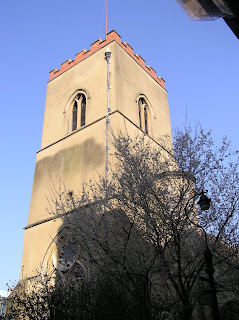 Photo #2 St. Benet's (Benedict's)
 Photo #3 The River Cam
Photo #4 Magdalen College court yard
photo #5 Inside Magdalen chapel
Photo #6 CS Lewis plaque
Photo #7 Colonial reformers
Photo #8 Thomas Clarkston

Photo #9 William Wilburforce
photo #10 Martin Luther
Photo #11 Trinity window/Key Reformation Figures
Photo #12 Lady Margaret Beaufort
Photo #13 John Fischer
Photo #14 Divinity School statues
Photo #15 Francis Bacon
Photo #16 King Henry VIII
Photo #17 Isaac Newton
Photo #18 Isaac Newton tree
Photo #19 Great St. Mary's
Photo #20 Senate House
Photo #21 Cambridge University Press
Photo #22 Little Germany Pub
Photo #23 Eagle Pub plaque
Photo #24 Cavendish Lab door
Photo #25 Cavendish Plaque
Photo #26 Sidney Sussex Court yard
Photo #27 Sussex Chapel


Photo #4 Magdalen College court yard

photo #5 Inside Magdalen chapel

Photo #6 CS Lewis plaque

Photo #7 Colonial reformers

Photo #8 Thomas Clarkston

Photo #9 William Wilburforce

photo #10 Martin Luther

Photo #11 Trinity window/Key Reformation Figures

Photo #12 Lady Margaret Beaufort

Photo #13 John Fischer

Photo #14 Divinity School statues

Photo #15 Francis Bacon

Photo #16 King Henry VIII

Photo #17 Isaac Newton

Photo #18 Isaac Newton tree

Photo #19 Great St. Mary's

Photo #20 Senate House

Photo #21 Cambridge University Press

Photo #22 Little Germany Pub

Photo #23 Eagle Pub plaque

Photo #24 Cavendish Lab door

Photo #25 Cavendish Plaque

Photo #26 Sidney Sussex Court yard

Photo #27 Sussex Chapel
Thursday, January 6, 2011
How Islamism and Secularity in the West are Related
ISLAM - VATICAN - EGYPT
Europe and Islam in the wake of attacks against Copts in Alexandria
by Samir Khalil Samir
Absurd accusations against the Coptic community of keeping two women who converted to Islam captive. The psychosis of a country that prohibits changing of religion. Islamic attacks against Shenouda, the criticism of the imam of Al-Azhar against Benedict XVI. Europe must open up channels for cultural dialogue with Islamic countries, rejecting secularism and fundamentalism. Just like the pope said.
Rome (AsiaNews) - The attack against the Church of Saints in Alexandria, Egypt, on December 31 last, shows in an increasing harsh light the growth of Christianophobia in the Islamic world (and beyond). It is important to denounce this violence, but also to find practical steps to counter it.
First, the facts: Muslims accuse the Egyptian Coptic Church and Patriarch Shenouda III, of holding two women who converted to Islam captive against their will in convents in Egypt. This accusation, which is completely false, was repeated on the very same day of the attack, on December 31. In the mosque 200 meters from the church attacked at midnight, following his imam’s sermon, there was a demonstration of Muslims calling for the release of these two women and all others.
This story has been dragging on for four years. It claims that the two women, Wafa 'Constantine and Camelia Shehata, who are married to two priests, had marital problems, that they then converted to Islam and were kidnapped and hidden by the Church. It is true that women had marital problems, but it is not true that they converted. In fact the late leader of Al-Azhar, Tantawi, decreed that there is no evidence of their conversion. The two women were then brought to the Church, who for fear of their possible kidnapping by Islamist movements, gave them refuge in convents. But the story keeps coming back to the surface. Even after the attack on the Syrian Catholic church in Baghdad on October 31 last year, the group that claimed responsibility for the terrorist act, cited the case of these two women, to justify attacks against Christians in Egypt.
All of this is absurd. Yesterday, I participated in an online forum of an Islamic newspaper, al-Mesreyya, discussing the attack on the church in Alexandria. Instead of expressing their condolences for the Christian victims, their horror at the attack, etc.. Everyone - at least 60 comments- said that "it is the Copts fault," and cited the story of the two women; that the attack on the church was organized by Copts themselves "to make us look bad in front of the rest of the world"; or something that was organized by the U.S. and Mossad. I posted a short comment, but it was not published. In the few lines I wrote, I asked what right is there to force a conversion? Conversions are in stifled in Egypt, that is, conversion to Islam is facilitated but those from Islam to another religion are strongly hindered.
The imam of Al-Azhar
In this situation the reaction of Ahmed al-Tayyeb, the current Imam of Al-Azhar, is understandable. He paid a visit to the Coptic Patriarch Shenouda III to express his condolences. In Egypt, these visits are a formality every time there is an attack, they imply “we always understand each other”, and "we should not destroy national unity." Thousands of Christians were demonstrating in front of the patriarchate to ask for more security and protection for Christians. The faithful reacted by shouting slogans and throwing stones at the car of the Muslim representative. But we must also take into consideration what Muslims do. Over the past three months several times a picture Shenouda was trampled upon and destroyed, and the names of 200 Copts are on a death list, with the patriarch in first place. Among them are 100 names of Canadian, German, Austrian and European Copts, and "shedding their blood – reads the list - is lawful." In this case too, the obsession with conversions is at the root of the violence.
The Egyptian government says that the attack on the church of Alexandria was carried out by foreigners. And in a way it's true: the Iraqi group linked to Al Qaeda that claimed responsibility for the Church attack in Baghdad on Oct. 31, threatened further violence if the two Egyptian women were not handed over to the Islamic community. Al Qaeda, whose leader is al-Zawahiri, an Egyptian, is in fact a widespread terrorist mafia with international branches.
The imam of Al-Azhar has criticized the pope for asking world governments to defend Christians and claims he does not care about Muslims killed in Iraq. That a figurehead such as he, considered a very learned and moderate man - he knows several languages and studied in Paris – should say such things against the pope is unacceptable: he has criticized the pope without really knowing anything, by simply repeating what he has read in the headlines[1].
In fact there is nothing to criticise in the Pope's address. Benedict XVI only recalled that violence against man is against the will of God. Of course he asked for help for Christians, seeing that he was referring to recent events. But even if he asked for increased security for Christians, is that really a scandal? If the governments of the Middle East are not able to defend them, because they do not want to or because they are not capable of doing so, then the world must do something, otherwise what's the UN or other international bodies for?
It is also ridiculous to say - as the imam of Ahzar did - that the pope has never defended the Muslims of Iraq. Neither John Paul II nor Benedict XVI ever approved of the American intervention of Iraq, nor believe that it was lawful. It must be said then that Muslims are often targeted and killed by other Muslims. The pope can condemn violence and say that we must defeat intolerance, and stop justifying violence in the name of God, but the pope has done this countless times.
The destiny of Europe and the Middle East
Some analysts warn against attempts by the West to exploit all this violence against Christians. In fact, however, in many European countries, Muslims continue to increase their demands, presenting them as their "rights"; they do unusual things and nobody says anything. For example, in France and Italy, Friday Muslim prayer takes place in public spaces, on the streets, blocking traffic.
Islam in Europe is becoming increasing more demanding and governments do not know how to react to it; some impede integration; the relationship between governments and Muslim immigrants is among the most difficult.
Of course, the vast majority of Muslims want peace, want to integrate, but among them there are people who have another project: we in Europe have the right to have our law, Shariah, and you prevent us from having this. A few years ago in Milan, the head of the Viale Jenner mosque, responding to a questions about conversions to Christianity in Egypt said “you simply have to apply the law”, which means the death of those who have converted. And if you condemn the application of the law then you are holding back our freedom of religion. This position is creating problems in France, Italy, Sweden, etc. ..
It is possible that European governments use violence against Christians to block Islamic emigration. Just as is it possible that Israel uses this violence to justify an ever more apparent racism in Israeli society. But violence against Christians is something that happens every day and has as its aim to rid the Middle East of the Christian presence. Bombings and killings are a constant reality in Egypt.
Dialogue to defeat fundamentalism and secularism
For this reason, some European countries are beginning to say "enough". There is the growing realization that something must be done. It is true that other attacks on the religious freedom of Christians in China or Vietnam or in Laos, are condemned, if only, sporadically. The fact is that the Middle East is closely tied to Europe and the problem of coexistence with Islam is a European problem. I am pleased with the unanimous response of the international community on the attack on the Copts in Egypt. What is striking in this case is the absolute innocence of the Copts: What have they done to deserve such a murderous attack? In other parts - Palestine, Iraq, Lebanon ... - there are acts of war, but there is none of this here in Egypt, it is a violent, gratuitous attack motivated only by "conversions" and just as we all ask for freedom religion, as in the pope's message for World Day of Peace.
The episode in Alexandria in Egypt is an act against religious freedom. But Muslims in the name of Shariah, are not able to understand the value of human rights. Human rights must come before all tradition and all laws, even sharia.
It must be said that this violence also involves the West. The pope, in his speech on 1 January, said that it concrete actions are needed and not just words. I think we need pay particular attention to the Middle Eastern or Islamic countries, or wherever violence against religious freedom occurs. It is no good putting pressure on these nations, because they see it as too much interference. The American proposal for collaboration with Islam, made by Barack Obama, does not arouse enthusiasm because the U.S. proposals then lapse into a form of colonialism.
The point is that the relationship with these countries must become not exclusively economic but also cultural. One of the main points of this dialogue is the need to take the fundamentalists criticism of Western civilization, which they see as atheist, seriously. The fundamentalists are full of critical errors, but they are based in reality. They see that the West promotes an irreligious culture. In fact, the West is either neutral or indifferent, or even contrary to religion. While fundamentalists promote Islamic religious culture.
We have to take the middle road between two extremes: the secularist West, in which there is no room for religion, or Islamic fundamentalist way in which religion penetrates, through force, all areas of life : prayer, work, sex, family, etc. ...
In the Angelus of January 1, the pope said: "Today we are witnessing two opposite trends, both negative, both extremes: on one hand, secularism, which often in a very deceitful way, marginalizes religion to confine it to the private sphere and on the other fundamentalism, which instead wants to impose it by force. " I really think the pope is right. We must reject both secularism and fundamentalism.
[1] Ahmed al-Tayyeb, the imam of Al Azhar, criticized the pope for – in his opinion - having only appealed for greater protection for Christians in his homily on 1 January. "I do not agree - he said - with the position of the pope and wonder why the pope did not ask for protection when they were killing Muslims in Iraq." In fact, the pope's words were: "Faced with the threatening tensions of the moment, especially in the face of religious discrimination, abuses and intolerance, which today affect Christians in particular (cf. ibid., 1), once again I address this urgent appeal to not give in to despair and resignation. I urge everyone to pray that the efforts undertaken by several parties to promote and build peace in the world come to fruition". It is true however, that many media have published headlines like "Pope calls on governments to protect Christians," with a clear reduction of the message.
http://www.asianews.it/news-en/Europe-and-Islam-in-the-wake-of-attacks-against-Copts-in-Alexandria-20410.html
Europe and Islam in the wake of attacks against Copts in Alexandria
by Samir Khalil Samir
Absurd accusations against the Coptic community of keeping two women who converted to Islam captive. The psychosis of a country that prohibits changing of religion. Islamic attacks against Shenouda, the criticism of the imam of Al-Azhar against Benedict XVI. Europe must open up channels for cultural dialogue with Islamic countries, rejecting secularism and fundamentalism. Just like the pope said.
Rome (AsiaNews) - The attack against the Church of Saints in Alexandria, Egypt, on December 31 last, shows in an increasing harsh light the growth of Christianophobia in the Islamic world (and beyond). It is important to denounce this violence, but also to find practical steps to counter it.
First, the facts: Muslims accuse the Egyptian Coptic Church and Patriarch Shenouda III, of holding two women who converted to Islam captive against their will in convents in Egypt. This accusation, which is completely false, was repeated on the very same day of the attack, on December 31. In the mosque 200 meters from the church attacked at midnight, following his imam’s sermon, there was a demonstration of Muslims calling for the release of these two women and all others.
This story has been dragging on for four years. It claims that the two women, Wafa 'Constantine and Camelia Shehata, who are married to two priests, had marital problems, that they then converted to Islam and were kidnapped and hidden by the Church. It is true that women had marital problems, but it is not true that they converted. In fact the late leader of Al-Azhar, Tantawi, decreed that there is no evidence of their conversion. The two women were then brought to the Church, who for fear of their possible kidnapping by Islamist movements, gave them refuge in convents. But the story keeps coming back to the surface. Even after the attack on the Syrian Catholic church in Baghdad on October 31 last year, the group that claimed responsibility for the terrorist act, cited the case of these two women, to justify attacks against Christians in Egypt.
All of this is absurd. Yesterday, I participated in an online forum of an Islamic newspaper, al-Mesreyya, discussing the attack on the church in Alexandria. Instead of expressing their condolences for the Christian victims, their horror at the attack, etc.. Everyone - at least 60 comments- said that "it is the Copts fault," and cited the story of the two women; that the attack on the church was organized by Copts themselves "to make us look bad in front of the rest of the world"; or something that was organized by the U.S. and Mossad. I posted a short comment, but it was not published. In the few lines I wrote, I asked what right is there to force a conversion? Conversions are in stifled in Egypt, that is, conversion to Islam is facilitated but those from Islam to another religion are strongly hindered.
The imam of Al-Azhar
In this situation the reaction of Ahmed al-Tayyeb, the current Imam of Al-Azhar, is understandable. He paid a visit to the Coptic Patriarch Shenouda III to express his condolences. In Egypt, these visits are a formality every time there is an attack, they imply “we always understand each other”, and "we should not destroy national unity." Thousands of Christians were demonstrating in front of the patriarchate to ask for more security and protection for Christians. The faithful reacted by shouting slogans and throwing stones at the car of the Muslim representative. But we must also take into consideration what Muslims do. Over the past three months several times a picture Shenouda was trampled upon and destroyed, and the names of 200 Copts are on a death list, with the patriarch in first place. Among them are 100 names of Canadian, German, Austrian and European Copts, and "shedding their blood – reads the list - is lawful." In this case too, the obsession with conversions is at the root of the violence.
The Egyptian government says that the attack on the church of Alexandria was carried out by foreigners. And in a way it's true: the Iraqi group linked to Al Qaeda that claimed responsibility for the Church attack in Baghdad on Oct. 31, threatened further violence if the two Egyptian women were not handed over to the Islamic community. Al Qaeda, whose leader is al-Zawahiri, an Egyptian, is in fact a widespread terrorist mafia with international branches.
The imam of Al-Azhar has criticized the pope for asking world governments to defend Christians and claims he does not care about Muslims killed in Iraq. That a figurehead such as he, considered a very learned and moderate man - he knows several languages and studied in Paris – should say such things against the pope is unacceptable: he has criticized the pope without really knowing anything, by simply repeating what he has read in the headlines[1].
In fact there is nothing to criticise in the Pope's address. Benedict XVI only recalled that violence against man is against the will of God. Of course he asked for help for Christians, seeing that he was referring to recent events. But even if he asked for increased security for Christians, is that really a scandal? If the governments of the Middle East are not able to defend them, because they do not want to or because they are not capable of doing so, then the world must do something, otherwise what's the UN or other international bodies for?
It is also ridiculous to say - as the imam of Ahzar did - that the pope has never defended the Muslims of Iraq. Neither John Paul II nor Benedict XVI ever approved of the American intervention of Iraq, nor believe that it was lawful. It must be said then that Muslims are often targeted and killed by other Muslims. The pope can condemn violence and say that we must defeat intolerance, and stop justifying violence in the name of God, but the pope has done this countless times.
The destiny of Europe and the Middle East
Some analysts warn against attempts by the West to exploit all this violence against Christians. In fact, however, in many European countries, Muslims continue to increase their demands, presenting them as their "rights"; they do unusual things and nobody says anything. For example, in France and Italy, Friday Muslim prayer takes place in public spaces, on the streets, blocking traffic.
Islam in Europe is becoming increasing more demanding and governments do not know how to react to it; some impede integration; the relationship between governments and Muslim immigrants is among the most difficult.
Of course, the vast majority of Muslims want peace, want to integrate, but among them there are people who have another project: we in Europe have the right to have our law, Shariah, and you prevent us from having this. A few years ago in Milan, the head of the Viale Jenner mosque, responding to a questions about conversions to Christianity in Egypt said “you simply have to apply the law”, which means the death of those who have converted. And if you condemn the application of the law then you are holding back our freedom of religion. This position is creating problems in France, Italy, Sweden, etc. ..
It is possible that European governments use violence against Christians to block Islamic emigration. Just as is it possible that Israel uses this violence to justify an ever more apparent racism in Israeli society. But violence against Christians is something that happens every day and has as its aim to rid the Middle East of the Christian presence. Bombings and killings are a constant reality in Egypt.
Dialogue to defeat fundamentalism and secularism
For this reason, some European countries are beginning to say "enough". There is the growing realization that something must be done. It is true that other attacks on the religious freedom of Christians in China or Vietnam or in Laos, are condemned, if only, sporadically. The fact is that the Middle East is closely tied to Europe and the problem of coexistence with Islam is a European problem. I am pleased with the unanimous response of the international community on the attack on the Copts in Egypt. What is striking in this case is the absolute innocence of the Copts: What have they done to deserve such a murderous attack? In other parts - Palestine, Iraq, Lebanon ... - there are acts of war, but there is none of this here in Egypt, it is a violent, gratuitous attack motivated only by "conversions" and just as we all ask for freedom religion, as in the pope's message for World Day of Peace.
The episode in Alexandria in Egypt is an act against religious freedom. But Muslims in the name of Shariah, are not able to understand the value of human rights. Human rights must come before all tradition and all laws, even sharia.
It must be said that this violence also involves the West. The pope, in his speech on 1 January, said that it concrete actions are needed and not just words. I think we need pay particular attention to the Middle Eastern or Islamic countries, or wherever violence against religious freedom occurs. It is no good putting pressure on these nations, because they see it as too much interference. The American proposal for collaboration with Islam, made by Barack Obama, does not arouse enthusiasm because the U.S. proposals then lapse into a form of colonialism.
The point is that the relationship with these countries must become not exclusively economic but also cultural. One of the main points of this dialogue is the need to take the fundamentalists criticism of Western civilization, which they see as atheist, seriously. The fundamentalists are full of critical errors, but they are based in reality. They see that the West promotes an irreligious culture. In fact, the West is either neutral or indifferent, or even contrary to religion. While fundamentalists promote Islamic religious culture.
We have to take the middle road between two extremes: the secularist West, in which there is no room for religion, or Islamic fundamentalist way in which religion penetrates, through force, all areas of life : prayer, work, sex, family, etc. ...
In the Angelus of January 1, the pope said: "Today we are witnessing two opposite trends, both negative, both extremes: on one hand, secularism, which often in a very deceitful way, marginalizes religion to confine it to the private sphere and on the other fundamentalism, which instead wants to impose it by force. " I really think the pope is right. We must reject both secularism and fundamentalism.
[1] Ahmed al-Tayyeb, the imam of Al Azhar, criticized the pope for – in his opinion - having only appealed for greater protection for Christians in his homily on 1 January. "I do not agree - he said - with the position of the pope and wonder why the pope did not ask for protection when they were killing Muslims in Iraq." In fact, the pope's words were: "Faced with the threatening tensions of the moment, especially in the face of religious discrimination, abuses and intolerance, which today affect Christians in particular (cf. ibid., 1), once again I address this urgent appeal to not give in to despair and resignation. I urge everyone to pray that the efforts undertaken by several parties to promote and build peace in the world come to fruition". It is true however, that many media have published headlines like "Pope calls on governments to protect Christians," with a clear reduction of the message.
http://www.asianews.it/news-en/Europe-and-Islam-in-the-wake-of-attacks-against-Copts-in-Alexandria-20410.html
Friday, September 24, 2010
Tina Beattie on "The New Athiests"
Cultural Sadomasochism and Religion in Britain: A Review of Tina Beattie’s The New Atheists: the Twilight of Reason & and the War on Religion
There is always a danger in making a book review blatantly autobiographical, as I am going to do here. But since I am writing purely for enjoyment and only to explore my own thoughts about Tina Beattie’s book The New Atheists: the Twilight of Reason & and the War on Religion, I am not only going to dispense with this common wisdom but go against it zestily. I discovered Beattie’s book only some two days ago and read it cover to cover over a period of 24 hours. As an American living in England working on a post graduate degree in Religious History over the past six months, and having been an English teacher in Saudi Arabia and having thought a lot about Islam during that time before coming to England, I found Beattie’s spoke to my experience of the religious scene in Britain on a number of levels. I admit to not having read Christopher Hitchens’ and Richard Dawkins’ scathing discussions of religion, which along with Sam Harris and some of the recent apologists for religion in the wake of Hitchens and Dawkins are the focus of Beattie’s book. But we hear so much about them here in Britain (I have in fact seen Harris lecture on cable television in the U.S.) and Beattie gives ample illustration of their discussions in the book, that it is not necessary—the need always to read an author in their own words notwithstanding.
Before talking about how it speaks to my perception of the religious mood of Britain at the present time, let me state what I believe Beattie is aiming to do. Here she aims to show: 1) how the new atheism is situated culturally and historically, and 2) how the new atheism and its rhetorical strategies, especially with regard to Dawkins, shows a basic disregard for civility and intolerance for rational debate at a time when they are desperately needed. These two themes are interrelated. For example, Beattie shows that the new atheists’ proclivity for finding a single rationality to which all of western civilization and beyond should ascribe, one which can only operate fully if the “superstitions” of religion are sloughed off, is similar to colonialist, imperialist and male-dominated types of thinking seen in the 18th and 19th century. There “men of science” attempted to rationalize colonial rule in Africa and Asia and clear it of any local and unincorporated conceptual and political impediments, as Beattie shows in some detail in the first few chapters.
There are other types of basic brush clearing done in the early chapter and where Beattie goes through typical assertions made by the new atheists in order to nuance the debate and bring civility to it. I particularly liked chapter 4 in which Beattie countered the notion found in new atheist writing that religion is a predominant cause of war throughout history. She shows that in the last 3000 years of history religion has been a cause in relatively few wars; the First and Second World War had nothing to do with religion; and if anything Nazism and the Cold War had much to do with Germany and Russia’s having broken away from their cultures’ Christian past. Beattie also shows that witch hunts of 17th century Europe had as much to do with the rise of scientific thinking and the desire to root out “superstition” and control women’s bodies and female subjectivity as it did with religion. The Spanish Inquisition was also counseled against by religious authority (124).
But more interesting for me is how Beattie speaks to what I am now sensing in my six-month-long stay in England with regards to how religion is regarded society-wide in Britain. Generalizing grossly about British views on religion (never a good thing to do), I believe it is fair to say that British society exhibits a set of tensions around religion which is as follows. On the one hand, there is a declining resonance between the British public and The Church of England, occurring for a number of reasons, one of which it its perceived attachment to colonialism and its being the established church. On the other hand we find an anti-Muslim sentiment population-wide, or at least an ambiguity toward Islam because of 9/11 and 7/7 fueled by strife within the British Muslim immigrant community. These frictions are fueled also by the perception that Britain was dragged foolishly into war in Iraq and Afghanistan by the United States, a country whose Christianity is seen as part of the problem, which positions me in interesting ways as part of the landscape being described here. The way to deal with these interrelated problems in British society, it appears to many, is to slough off any attachment to religion, Christian or Muslim or other, a notion found not only among the new atheists.
While the above is my take on the issue, Beattie does not deny these tensions either. She shows us furthermore how these tensions are fed by secular impulses in British society which were rejected in the 7/7 attacks. I would add that there are some conversions to Islam among the British population, some 30,000 or so, who I would argue have been led to Islam because it is seen, at least partly, as way of being countercultural and counter-hegemonic, also part of the rejection of British secularism seen among British Muslisms of Islamic heritage. Conversion to Islam in Britain is also part of the declining numbers in Church of England attendance because of its perceived lack of cultural relevance, which is again part of an impulse which feeds and has been fed by the new atheism and its counterpart in the new fundamentalism in its Christian guises (see 137). Teenage pregnancy, Beattie points out, is among the highest in Europe (146). This and the Freudian influenced sexuality-expressed-will-make-you-free secularism has also contributed to conversions to Islam and to its militancy, or at least its stridency, among the British Islamic community, the female among whom are much more zealous in wearing the hijab in public as a statement of their rejection of this secularism than they were in years past.
Whether or not we need to remedy the current situation depends on where you stand. But that the social landscape sketched about is not civil and is tense on the ground here is beyond question. While I have taken my discussion in a direction different form the main direction charted by Beattie, these concerns are not absent in Beattie’s treatment. Nor do we differ on how they might be treated. Beattie does not use the term “cultural sadomasochism” as I do (to define a strain within the new atheism and paradoxically another strand of society thinking that Islam is counter cultural and anti-imperial) but she does, for example, discuss the way in which Christian roots can be pointed to for European modernity and scientific reason and the placing of the individual at the center of history, therefore suggesting that ignoring these roots is tantamount to cultural masochism. Beattie also mentions thinkers such as Alasdair MacIntyre who advocate a return to the Aristotelian and Christian views of rationality of the Middle Ages (144). This could not only be a way of forming common ground with Muslims and Jews, both of whom share in the Medieval Aristotelian heritage which the West inherited from the Levant (116), but also a way of finding common ground between religion and science. On this score as well, Beattie has a fascinating discussion of the new physics how it might relate to this medieval and sacramental view of the world. She also mentions how the Protestant Reformers, having come to see human nature as corrupted and grace being divorced from nature, also played a role in the overly narrow version of rationality and the science and theology split we find in the new atheism (58).
Beattie’s final salvo in my view begins with a discussion of Nietzsche and his thoughts on language and power (150). This is made part of an argument suggesting that if the language of or about God is to once again speak to contemporary Westerners it must be part of a renewed campaign for civility, one not afraid to campaign against church abuses as well (such as the Vatican’s failure to prosecute its own with links to Nazism). Nietzsche and the Postmoderns have shown us that language is part of its context: if this God language will once again have meaning, we must be once again good to one another. Literature, Narrative Theology and Holocaust thinkers such as Eli Weisel also show us how to move “beyond thinking of God as a philosophical conundrum” as is the case in the new atheism (152).
Beattie shows us in the last two chapters of the book how the relationship between God, humanity and contemporary history itself seemingly can be thought of as a literary character that stands free from the mind of its author as it speaks its truth and comes to life. This section stands as a dénouement to a postcolonial feminist Catholic analysis that may or not be able to stem the tide of cultural sadomasochism I see in Britain as it moves further away form the Christian tradition that partly built Europe and it. But if the heart of the Christian message is one of civility and integrative complexity, one where science and religion are allowed to inform one another and become subsumed within a rationality which allows for dialogue and organic growth among the social body where it is found, then the cultural sadomasochism that I see in contemporary British liberalism as well as Western liberalism as a whole might be able to be addressed, and addressed by some of the ideas found in this book. The ideas about Narrative Theology found here as well as those about the New Physics resonate with the Emerging Church movement, now worldwide, and with the Sojourners magazine inspired Social Gospel Christianity stemming from the United States.
There is always a danger in making a book review blatantly autobiographical, as I am going to do here. But since I am writing purely for enjoyment and only to explore my own thoughts about Tina Beattie’s book The New Atheists: the Twilight of Reason & and the War on Religion, I am not only going to dispense with this common wisdom but go against it zestily. I discovered Beattie’s book only some two days ago and read it cover to cover over a period of 24 hours. As an American living in England working on a post graduate degree in Religious History over the past six months, and having been an English teacher in Saudi Arabia and having thought a lot about Islam during that time before coming to England, I found Beattie’s spoke to my experience of the religious scene in Britain on a number of levels. I admit to not having read Christopher Hitchens’ and Richard Dawkins’ scathing discussions of religion, which along with Sam Harris and some of the recent apologists for religion in the wake of Hitchens and Dawkins are the focus of Beattie’s book. But we hear so much about them here in Britain (I have in fact seen Harris lecture on cable television in the U.S.) and Beattie gives ample illustration of their discussions in the book, that it is not necessary—the need always to read an author in their own words notwithstanding.
Before talking about how it speaks to my perception of the religious mood of Britain at the present time, let me state what I believe Beattie is aiming to do. Here she aims to show: 1) how the new atheism is situated culturally and historically, and 2) how the new atheism and its rhetorical strategies, especially with regard to Dawkins, shows a basic disregard for civility and intolerance for rational debate at a time when they are desperately needed. These two themes are interrelated. For example, Beattie shows that the new atheists’ proclivity for finding a single rationality to which all of western civilization and beyond should ascribe, one which can only operate fully if the “superstitions” of religion are sloughed off, is similar to colonialist, imperialist and male-dominated types of thinking seen in the 18th and 19th century. There “men of science” attempted to rationalize colonial rule in Africa and Asia and clear it of any local and unincorporated conceptual and political impediments, as Beattie shows in some detail in the first few chapters.
There are other types of basic brush clearing done in the early chapter and where Beattie goes through typical assertions made by the new atheists in order to nuance the debate and bring civility to it. I particularly liked chapter 4 in which Beattie countered the notion found in new atheist writing that religion is a predominant cause of war throughout history. She shows that in the last 3000 years of history religion has been a cause in relatively few wars; the First and Second World War had nothing to do with religion; and if anything Nazism and the Cold War had much to do with Germany and Russia’s having broken away from their cultures’ Christian past. Beattie also shows that witch hunts of 17th century Europe had as much to do with the rise of scientific thinking and the desire to root out “superstition” and control women’s bodies and female subjectivity as it did with religion. The Spanish Inquisition was also counseled against by religious authority (124).
But more interesting for me is how Beattie speaks to what I am now sensing in my six-month-long stay in England with regards to how religion is regarded society-wide in Britain. Generalizing grossly about British views on religion (never a good thing to do), I believe it is fair to say that British society exhibits a set of tensions around religion which is as follows. On the one hand, there is a declining resonance between the British public and The Church of England, occurring for a number of reasons, one of which it its perceived attachment to colonialism and its being the established church. On the other hand we find an anti-Muslim sentiment population-wide, or at least an ambiguity toward Islam because of 9/11 and 7/7 fueled by strife within the British Muslim immigrant community. These frictions are fueled also by the perception that Britain was dragged foolishly into war in Iraq and Afghanistan by the United States, a country whose Christianity is seen as part of the problem, which positions me in interesting ways as part of the landscape being described here. The way to deal with these interrelated problems in British society, it appears to many, is to slough off any attachment to religion, Christian or Muslim or other, a notion found not only among the new atheists.
While the above is my take on the issue, Beattie does not deny these tensions either. She shows us furthermore how these tensions are fed by secular impulses in British society which were rejected in the 7/7 attacks. I would add that there are some conversions to Islam among the British population, some 30,000 or so, who I would argue have been led to Islam because it is seen, at least partly, as way of being countercultural and counter-hegemonic, also part of the rejection of British secularism seen among British Muslisms of Islamic heritage. Conversion to Islam in Britain is also part of the declining numbers in Church of England attendance because of its perceived lack of cultural relevance, which is again part of an impulse which feeds and has been fed by the new atheism and its counterpart in the new fundamentalism in its Christian guises (see 137). Teenage pregnancy, Beattie points out, is among the highest in Europe (146). This and the Freudian influenced sexuality-expressed-will-make-you-free secularism has also contributed to conversions to Islam and to its militancy, or at least its stridency, among the British Islamic community, the female among whom are much more zealous in wearing the hijab in public as a statement of their rejection of this secularism than they were in years past.
Whether or not we need to remedy the current situation depends on where you stand. But that the social landscape sketched about is not civil and is tense on the ground here is beyond question. While I have taken my discussion in a direction different form the main direction charted by Beattie, these concerns are not absent in Beattie’s treatment. Nor do we differ on how they might be treated. Beattie does not use the term “cultural sadomasochism” as I do (to define a strain within the new atheism and paradoxically another strand of society thinking that Islam is counter cultural and anti-imperial) but she does, for example, discuss the way in which Christian roots can be pointed to for European modernity and scientific reason and the placing of the individual at the center of history, therefore suggesting that ignoring these roots is tantamount to cultural masochism. Beattie also mentions thinkers such as Alasdair MacIntyre who advocate a return to the Aristotelian and Christian views of rationality of the Middle Ages (144). This could not only be a way of forming common ground with Muslims and Jews, both of whom share in the Medieval Aristotelian heritage which the West inherited from the Levant (116), but also a way of finding common ground between religion and science. On this score as well, Beattie has a fascinating discussion of the new physics how it might relate to this medieval and sacramental view of the world. She also mentions how the Protestant Reformers, having come to see human nature as corrupted and grace being divorced from nature, also played a role in the overly narrow version of rationality and the science and theology split we find in the new atheism (58).
Beattie’s final salvo in my view begins with a discussion of Nietzsche and his thoughts on language and power (150). This is made part of an argument suggesting that if the language of or about God is to once again speak to contemporary Westerners it must be part of a renewed campaign for civility, one not afraid to campaign against church abuses as well (such as the Vatican’s failure to prosecute its own with links to Nazism). Nietzsche and the Postmoderns have shown us that language is part of its context: if this God language will once again have meaning, we must be once again good to one another. Literature, Narrative Theology and Holocaust thinkers such as Eli Weisel also show us how to move “beyond thinking of God as a philosophical conundrum” as is the case in the new atheism (152).
Beattie shows us in the last two chapters of the book how the relationship between God, humanity and contemporary history itself seemingly can be thought of as a literary character that stands free from the mind of its author as it speaks its truth and comes to life. This section stands as a dénouement to a postcolonial feminist Catholic analysis that may or not be able to stem the tide of cultural sadomasochism I see in Britain as it moves further away form the Christian tradition that partly built Europe and it. But if the heart of the Christian message is one of civility and integrative complexity, one where science and religion are allowed to inform one another and become subsumed within a rationality which allows for dialogue and organic growth among the social body where it is found, then the cultural sadomasochism that I see in contemporary British liberalism as well as Western liberalism as a whole might be able to be addressed, and addressed by some of the ideas found in this book. The ideas about Narrative Theology found here as well as those about the New Physics resonate with the Emerging Church movement, now worldwide, and with the Sojourners magazine inspired Social Gospel Christianity stemming from the United States.
Sunday, March 7, 2010
An Emerging Remnant
"Take a jar and put a piece of manna in it. Then place it before the lord to be kept for the generations to come" (Ex 16:33)
There are lots of references to "the remnant" in the Hebrew bible, and this is not necessarily one of them. But it's in the same ball park.
I haven't posted in nearly a year and a half here. And it's taken me weeks to find a new title for the blog that fits where my head is at now such as to allow me to post again. I think I've found it.
A "remnant" is what I feel like my religion is for me at this point. It's also a good way of referring to how my religion exists within the British culture, at least as far as I see it, in which I find myself living at the moment. The Emerging Church movement can I believe be a way of fanning the flames in which this remnant once lived, and on occasion very much still lives, in myself and in this culture.
There are lots of references to "the remnant" in the Hebrew bible, and this is not necessarily one of them. But it's in the same ball park.
I haven't posted in nearly a year and a half here. And it's taken me weeks to find a new title for the blog that fits where my head is at now such as to allow me to post again. I think I've found it.
A "remnant" is what I feel like my religion is for me at this point. It's also a good way of referring to how my religion exists within the British culture, at least as far as I see it, in which I find myself living at the moment. The Emerging Church movement can I believe be a way of fanning the flames in which this remnant once lived, and on occasion very much still lives, in myself and in this culture.
Wednesday, September 24, 2008
St Ephraim, "Evil Doers," and Global Ecumenicism
I refer to St. Ephraim when it is largely no longer customary to refer to Patristic writers as saints. The reason for this, as it was once told to me, was that “they were all saints” and “they all referred to each other this way.” I suspect there may be a little Catholic vs. Protestant in stripping these saints of their former titles. I believe restoring the title in the case of St. Ephraim is warranted for two reasons: 1) he simply deserves it, reasons why stated below 2) there were so many people and places named Ephraim in antiquity, especially Semitic antiquity, that it is a useful way of distinguishing among them. 3) I happen to like the overdetermined nature of term and signifier and the uneasiness it causes. That having been said, I may on occasion slip and call him simply Ephraim because it is easier.
Ephraim the Syrian (another of his appellations) wrote over five hundred hymns and theological treatises in the middle of the fourth century. One way of celebrating his importance, and there are several, is by turning to the relationships between theology and "interfaith" practice seen in his writings. It is said that Ephraim did not turn to hymn writing until he saw the importance of it in the Manichean church under the influence of Bardaisan in the region in which both he and Ephraim lived. Edessa was the capitol of once Byzantine controlled Syria which had recently come under the control of Persia. Stanley Hauerwas says that "one reason why we Christians argue so much about which hymn to sing, which liturgy to follow, which way to worship is that the commandments teach us to believe that bad liturgy eventually leads to bad ethics. You begin by singing some sappy, sentimental hymn, then you pray some pointless prayer, and the next thing you know you have murdered your best friend." In Ephraim’s Edessa, where Persian and Byzatine political influence interacted with religious ideas stemming from the followers of Nicean orthodoxy, Manichean schools of thought and practice and various shades of Gnostic influence and all of these competed with on another, Haeurwas’ observation was as true then as it is today.
In the First Discourse Against The False Teachers, a theological treatise in the form of a letter, which Ephraim wrote to a follower of Bardaisan named Hypatius, we find ideas that speak to the present day. In my view, the most important ecumenical question of our day is not how Christian denominations can find common groud, indeed an important question, but how religions can find common ground to talk to one another. A subset of this is how to maintain and celebrate differences while still entering into dialog. The “clash of civilzations,” in Samuel Huntington’s phraeology, which did not exist in any way before 9/11 like it did after it, is something which has broght Christian denominations closer to one another at the same that it has pushed Christians and Muslims apart. This has nullified old needs but created new ones.
In this text St. Ephraim is urging accord between followers of Nicean orthodoxy and Manichean teacher Bardaisan. He is also attacking the doctrine of determinism that stems from Bardaisan and arguing instead for an understanding of Free Will. I could not help but see connections between President George W. Bush’s War on Terror, his references to “evil doers,” and current conflicts between the at least nominaly Christian world (which extends arguably from California eastward through the U.S. Europe and on to South Korea) and the Muslim world (which covers at least swaths of almost everthing else minus China and India). Bush’s worldview has more than once been called “Manichaean.”
Ephraim’s advice to the Manicheans of his day and those in ours is the following. Speaking of an ontological mixture of good and evil in the world and in our own souls is not only a denial of free will, it is blasphemous, he says. Doing so denies our ability to change and redirect our lives, as well as our ability to see this in others. “Whoever denies that there is Freewill utters a great blasphemy in that he hastens to ascribe his vices to God”(sec 24). “How was He who was unable to give Freewill able to give a Law when there was no Freewill? But if He gave the Law, the righteousness which is in His Law censures our Freewill, for he rewards it according to its works.” (sec 27)
While one may suggest that the decidely Christian character of Ephraim’s First Discourse would be offensive to Muslims, I would aruge that Ephraim’s world-view is sufficiently Abrhamaic and stemming from the ancient Semitic Patrarchs to allow it to speak to Muslims. The notion that God’s law interacts with and is impossible without human freewill is found in Islam and Judaism. St. Ephraim says God’s multivariate body (an ecumenical image if there ever was one) is like Mt. Sinai with Moses standing at its top. “All those who are like Moses are near to his holiness like Moses, and form one body ..and by means of that body, too,which our Lord was raised, all bodies have received a pledge that they will be raised in like manner.” (sec 5). There are a number of other helpful ecumencial images in this work of Ephraim, but none are as helpful as the idea that our souls and bodies are basically pure. While evil exists along with those who do evil, it is the will of these individuals which is the cause of this rather than the structure of the cosmos or the human psyche. This is a useful thing to keep in mind as Pakistan attempts to deal with political unrest and a new Prime Minister, and we realize it was not “the surge” alone that caused a drop in violence in Iraq recently, but rather individuals assocaited with the Awakening Councils along with Muqtadar AlSadr’s militians who decided to stop the violence they chose to engage in rather than ontological violence stemming from their non-Christian souls.
Ephraim the Syrian (another of his appellations) wrote over five hundred hymns and theological treatises in the middle of the fourth century. One way of celebrating his importance, and there are several, is by turning to the relationships between theology and "interfaith" practice seen in his writings. It is said that Ephraim did not turn to hymn writing until he saw the importance of it in the Manichean church under the influence of Bardaisan in the region in which both he and Ephraim lived. Edessa was the capitol of once Byzantine controlled Syria which had recently come under the control of Persia. Stanley Hauerwas says that "one reason why we Christians argue so much about which hymn to sing, which liturgy to follow, which way to worship is that the commandments teach us to believe that bad liturgy eventually leads to bad ethics. You begin by singing some sappy, sentimental hymn, then you pray some pointless prayer, and the next thing you know you have murdered your best friend." In Ephraim’s Edessa, where Persian and Byzatine political influence interacted with religious ideas stemming from the followers of Nicean orthodoxy, Manichean schools of thought and practice and various shades of Gnostic influence and all of these competed with on another, Haeurwas’ observation was as true then as it is today.
In the First Discourse Against The False Teachers, a theological treatise in the form of a letter, which Ephraim wrote to a follower of Bardaisan named Hypatius, we find ideas that speak to the present day. In my view, the most important ecumenical question of our day is not how Christian denominations can find common groud, indeed an important question, but how religions can find common ground to talk to one another. A subset of this is how to maintain and celebrate differences while still entering into dialog. The “clash of civilzations,” in Samuel Huntington’s phraeology, which did not exist in any way before 9/11 like it did after it, is something which has broght Christian denominations closer to one another at the same that it has pushed Christians and Muslims apart. This has nullified old needs but created new ones.
In this text St. Ephraim is urging accord between followers of Nicean orthodoxy and Manichean teacher Bardaisan. He is also attacking the doctrine of determinism that stems from Bardaisan and arguing instead for an understanding of Free Will. I could not help but see connections between President George W. Bush’s War on Terror, his references to “evil doers,” and current conflicts between the at least nominaly Christian world (which extends arguably from California eastward through the U.S. Europe and on to South Korea) and the Muslim world (which covers at least swaths of almost everthing else minus China and India). Bush’s worldview has more than once been called “Manichaean.”
Ephraim’s advice to the Manicheans of his day and those in ours is the following. Speaking of an ontological mixture of good and evil in the world and in our own souls is not only a denial of free will, it is blasphemous, he says. Doing so denies our ability to change and redirect our lives, as well as our ability to see this in others. “Whoever denies that there is Freewill utters a great blasphemy in that he hastens to ascribe his vices to God”(sec 24). “How was He who was unable to give Freewill able to give a Law when there was no Freewill? But if He gave the Law, the righteousness which is in His Law censures our Freewill, for he rewards it according to its works.” (sec 27)
While one may suggest that the decidely Christian character of Ephraim’s First Discourse would be offensive to Muslims, I would aruge that Ephraim’s world-view is sufficiently Abrhamaic and stemming from the ancient Semitic Patrarchs to allow it to speak to Muslims. The notion that God’s law interacts with and is impossible without human freewill is found in Islam and Judaism. St. Ephraim says God’s multivariate body (an ecumenical image if there ever was one) is like Mt. Sinai with Moses standing at its top. “All those who are like Moses are near to his holiness like Moses, and form one body ..and by means of that body, too,which our Lord was raised, all bodies have received a pledge that they will be raised in like manner.” (sec 5). There are a number of other helpful ecumencial images in this work of Ephraim, but none are as helpful as the idea that our souls and bodies are basically pure. While evil exists along with those who do evil, it is the will of these individuals which is the cause of this rather than the structure of the cosmos or the human psyche. This is a useful thing to keep in mind as Pakistan attempts to deal with political unrest and a new Prime Minister, and we realize it was not “the surge” alone that caused a drop in violence in Iraq recently, but rather individuals assocaited with the Awakening Councils along with Muqtadar AlSadr’s militians who decided to stop the violence they chose to engage in rather than ontological violence stemming from their non-Christian souls.
Monday, September 22, 2008
Obama on the economy
I stole this off the net, but this person probably did the same. That is how the net works. Let's spread useful, in this case VERY useful information. Obama gave this economic speech on March 27th. See anything that indicates foresight?
Obama:
But the American experiment has worked in large part because we have guided the market's invisible hand with a higher principle. Our free market was never meant to be a free license to take whatever you can get, however you can get it. That is why we have put in place rules of the road to make competition fair, and open, and honest. We have done this not to stifle - but rather to advance prosperity and liberty. As I said at NASDAQ last September: the core of our economic success is the fundamental truth that each American does better when all Americans do better; that the well being of American business, its capital markets, and the American people are aligned.
I think all of us here today would acknowledge that we've lost that sense of shared prosperity.
This loss has not happened by accident. It's because of decisions made in boardrooms, on trading floors and in Washington. Under Republican and Democratic Administrations, we failed to guard against practices that all too often rewarded financial manipulation instead of productivity and sound business practices. We let the special interests put their thumbs on the economic scales. The result has been a distorted market that creates bubbles instead of steady, sustainable growth; a market that favors Wall Street over Main Street, but ends up hurting both...
I do not believe that government should stand in the way of innovation, or turn back the clock to an older era of regulation. But I do believe that government has a role to play in advancing our common prosperity: by providing stable macroeconomic and financial conditions for sustained growth; by demanding transparency; and by ensuring fair competition in the marketplace.
Our history should give us confidence that we don't have to choose between an oppressive government-run economy and a chaotic and unforgiving capitalism. It tells us we can emerge from great economic upheavals stronger, not weaker. But we can do so only if we restore confidence in our markets. Only if we rebuild trust between investors and lenders. And only if we renew that common interest between Wall Street and Main Street that is the key to our success...
We need to regulate institutions for what they do, not what they are. Over the last few years, commercial banks and thrift institutions were subject to guidelines on subprime mortgages that did not apply to mortgage brokers and companies. It makes no sense for the Fed to tighten mortgage guidelines for banks when two-thirds of subprime mortgages don't originate from banks. This regulatory framework has failed to protect homeowners, and it is now clear that it made no sense for our financial system. When it comes to protecting the American people, it should make no difference what kind of institution they are dealing with.
This seems to be the right argument for regulation. I'm on record as proclaiming the death of Reaganomics. The notion that government is the problem has been proven false. Without proper government oversight, the markets run wild, salaries for the wealthiest explode, and the cost of basic needs (gas, food, housing, health insurance) soar.
Let's hope America wakes up and gives the dunces who have fostered this style of economics for the past 30 years the boot.
Obama:
But the American experiment has worked in large part because we have guided the market's invisible hand with a higher principle. Our free market was never meant to be a free license to take whatever you can get, however you can get it. That is why we have put in place rules of the road to make competition fair, and open, and honest. We have done this not to stifle - but rather to advance prosperity and liberty. As I said at NASDAQ last September: the core of our economic success is the fundamental truth that each American does better when all Americans do better; that the well being of American business, its capital markets, and the American people are aligned.
I think all of us here today would acknowledge that we've lost that sense of shared prosperity.
This loss has not happened by accident. It's because of decisions made in boardrooms, on trading floors and in Washington. Under Republican and Democratic Administrations, we failed to guard against practices that all too often rewarded financial manipulation instead of productivity and sound business practices. We let the special interests put their thumbs on the economic scales. The result has been a distorted market that creates bubbles instead of steady, sustainable growth; a market that favors Wall Street over Main Street, but ends up hurting both...
I do not believe that government should stand in the way of innovation, or turn back the clock to an older era of regulation. But I do believe that government has a role to play in advancing our common prosperity: by providing stable macroeconomic and financial conditions for sustained growth; by demanding transparency; and by ensuring fair competition in the marketplace.
Our history should give us confidence that we don't have to choose between an oppressive government-run economy and a chaotic and unforgiving capitalism. It tells us we can emerge from great economic upheavals stronger, not weaker. But we can do so only if we restore confidence in our markets. Only if we rebuild trust between investors and lenders. And only if we renew that common interest between Wall Street and Main Street that is the key to our success...
We need to regulate institutions for what they do, not what they are. Over the last few years, commercial banks and thrift institutions were subject to guidelines on subprime mortgages that did not apply to mortgage brokers and companies. It makes no sense for the Fed to tighten mortgage guidelines for banks when two-thirds of subprime mortgages don't originate from banks. This regulatory framework has failed to protect homeowners, and it is now clear that it made no sense for our financial system. When it comes to protecting the American people, it should make no difference what kind of institution they are dealing with.
This seems to be the right argument for regulation. I'm on record as proclaiming the death of Reaganomics. The notion that government is the problem has been proven false. Without proper government oversight, the markets run wild, salaries for the wealthiest explode, and the cost of basic needs (gas, food, housing, health insurance) soar.
Let's hope America wakes up and gives the dunces who have fostered this style of economics for the past 30 years the boot.
Saturday, September 20, 2008
Not facing Mecca, or Washington, but the Body
I want to follow up on the Yoga post I made the other day and Seane Corn's thoughts on Yoga. She says, as I quoted her, that we cannot approach God through the head but have to do it through the body. This gets us into feeling and feeling gets us to surrender.
Since I have been in Saudi Arabia I have done Yoga hundreds of times. But every time I do it I face away from the direction of Mecca and instead face the east, the land of the Buddha and the Dharma. This is partly a revolt against Islam. But it is also a taking on of their practices too, since some Yoga poses, such as Down Dogs, clearly involve prostration and a kind of submission. So am I moving toward Islam or away from it? Both, probably. I believe I am on the verge of something here and simply wanted to say that this is probably Seane Corn territory.
Speaking of the body as an avenue away from and to God, lately I have been very irritated at Republicans in my country and their embrace of Sara Palin. I get so angry with Republicans that I loose all perspective. I have begun recently to give this to my yoga practice and dedicate it to all those who I know who feel the same way. New Age silliness you say? Suggesting that it is not is this verse from Matthew which jumped out at me the other day. You may not think the body can be thought of as a kind of altar upon which we lay our junk, but we have several major world traditions saying something contrary. It also suggests that Yoga may be a way of facing neither Mecca, nor Washington but the body and that place where "we move and have our being."
Matthew 5:21-26
21 “You have heard that it was said to those of old, ‘You shall not murder; and whoever murders will be liable to judgment.’ 22 But I say to you that everyone who is angry with his brother [15] will be liable to judgment; whoever insults [16] his brother will be liable to the council; and whoever says, ‘You fool!’ will be liable to the hell [17] of fire. 23 So if you are offering your gift at the altar and there remember that your brother has something against you, 24 leave your gift there before the altar and go. First be reconciled to your brother, and then come and offer your gift. 25 Come to terms quickly with your accuser while you are going with him to court, lest your accuser hand you over to the judge, and the judge to the guard, and you be put in prison. 26 Truly, I say to you, you will never get out until you have paid the last penny. [18]
Since I have been in Saudi Arabia I have done Yoga hundreds of times. But every time I do it I face away from the direction of Mecca and instead face the east, the land of the Buddha and the Dharma. This is partly a revolt against Islam. But it is also a taking on of their practices too, since some Yoga poses, such as Down Dogs, clearly involve prostration and a kind of submission. So am I moving toward Islam or away from it? Both, probably. I believe I am on the verge of something here and simply wanted to say that this is probably Seane Corn territory.
Speaking of the body as an avenue away from and to God, lately I have been very irritated at Republicans in my country and their embrace of Sara Palin. I get so angry with Republicans that I loose all perspective. I have begun recently to give this to my yoga practice and dedicate it to all those who I know who feel the same way. New Age silliness you say? Suggesting that it is not is this verse from Matthew which jumped out at me the other day. You may not think the body can be thought of as a kind of altar upon which we lay our junk, but we have several major world traditions saying something contrary. It also suggests that Yoga may be a way of facing neither Mecca, nor Washington but the body and that place where "we move and have our being."
Matthew 5:21-26
21 “You have heard that it was said to those of old, ‘You shall not murder; and whoever murders will be liable to judgment.’ 22 But I say to you that everyone who is angry with his brother [15] will be liable to judgment; whoever insults [16] his brother will be liable to the council; and whoever says, ‘You fool!’ will be liable to the hell [17] of fire. 23 So if you are offering your gift at the altar and there remember that your brother has something against you, 24 leave your gift there before the altar and go. First be reconciled to your brother, and then come and offer your gift. 25 Come to terms quickly with your accuser while you are going with him to court, lest your accuser hand you over to the judge, and the judge to the guard, and you be put in prison. 26 Truly, I say to you, you will never get out until you have paid the last penny. [18]
Thursday, September 18, 2008
Yoga, Seane Corn, Christianity
Since hardly anyone reads this blog on any regular basis, you won't know that I occassionaly brag about NPR's Speaking of Faith Program. But I do. I am not whining, it's true. I don't care if anyone reads this blog. I am writing for me and that reader of writers in me.
SOF ran an excellent program this week on Yoga with yoga teacher Seane Corn. You really need to hear this one, and can't see how genuine and on the money she is from this excerpt from the transcript. But I put a couple of sections from the interview with her in order show how Christianity and Yoga can work together. It was a highly revealing interview for me.
There are some 20 million people across the U.S. that are doing yoga on a regular bassis, and there are far more outside that country. If we can't connect Christianity with some of the gems that are coming to us and through the issues talked about here, then we are missing a major opportunity. I am quoting way more than I should here, but just sort of can't help it. And you should hear what she says about working with junkie and prostitute teenagers, which I have not put here. Gotta' go online for that, which is here http://speakingoffaith.publicradio.org/
---------------------------------------------------------
Ms. Tippett: Let's talk about some of the words that you use in the context of yoga that in fact are spiritual words, like "grace." Talk about invoking the energy of grace in a yoga practice. I don't think that would make sense to many people.
Ms. Corn: I think that there's a lot of ways. I think first I need to define my relationship with God. I talk about God all the time in class, and I'm pretty confident in my relationship with God. And therefore, I'm comfortable using the word. But when I define spirit, it's that which exists within that's of truth and love. And so when I refer to grace or to spirit or to God, I'm talking of truth and love.
Ms. Tippett: And so, I mean, again, and this is kind of the same theme, when you say that the heart of the practice of yoga is love, you know, what do you mean by that?
Ms. Corn: Yeah.
Ms. Tippett: How can love be the heart of this practice of a series of physical poses and breathing?
Ms. Corn: It comes down to this for me: You can't get to God through your head, at least in my experience. I might come back in 20 years and say, you know, "Remember everything I was saying at 41? I was totally wrong." But how I've experienced it is that you can't get to God through your head, because it's determined by your five senses, so therefore we're limited to what we know, what we see, what we've experienced here on earth. For me, I've only been able to get to God through my heart, not through what I know but through what I feel because feelings lead to surrender. Surrender allows you to step into that unknown state where there's a different level of acceptance to what is rather than what you're choosing it to be. So for me, you release the tension, it opens you up to feelings, feelings connect you to surrender, and suddenly you're hearing with a new ear that moves beyond human interpretation but to spiritual perception which is infinite and limitless.
Ms. Corn: Yeah. Yeah. Another aspect is actually using your body to pray.
Ms. Tippett: Well, talk to me about that. Body prayer is something you do.
Ms. Corn: Yeah. Well, again, it all connects ultimately back to service, which is also, you know, kind of the evolution of the work that I've done. But using your body to pray. I trust that if I do my yoga practice, I'm going to get stronger and more flexible. If I stay in alignment, if I don't push, if I don't force, then my body will organically open in time. I know that if I breathe deeply, I'll oxygenate my body. It has an influence on my nervous system. These things are fixed and I know to be true. But I also recognize that it's a mystical practice, and you can use your body as an expression of your devotion. So the way that you place your hands, the ways that you step a foot forward or back, everything is done as an offering. I offer the movements to someone I love or to the healing of the planet. And so if I'm moving from a state of love and my heart is open to that connection between myself and another person or myself and the universe, it becomes an active form of prayer, of meditation, of grace.---------------------------------------------------------------------------------
------------------------------------------------------------------
Ms. Tippett: I want to ask you if these experiences of yours, these insights, and especially the work you do with child prostitutes, there's also this shadow side of this observation that mind, body, and spirit are linked. We know that when there is sexual violence, when there is rape or, you know, when there's sexual abuse, it's not just bodies that suffer; it's the soul.
Ms. Corn: Mm-hmm.
Ms. Tippett: How has yoga helped you understand that more deeply?
Ms. Corn: Well, again, it goes back into my own history, and it all lines — you know, it's all interdependent and connected and that's where I see the god. My first experience of betrayal, perhaps, was molestation at six years old. And I'm very public with this. I've talked about this frequently because it's led me to where I am today. It's where I find so much gratitude, and I marvel at how one thing can become something else. When you're a child, you have no — I had no sense of sexuality, of course, yet I experienced both panic and pleasure. And I didn't know what pleasure was, so I felt ashamed and guilty. And, again, this is not something I was conscious about. I was very aware of the molestation, but I wasn't as conscious of the intricacies that I'm sharing with you.
Ms. Tippett: Right. Right.
Ms. Corn: That came later. And so when I went through my own journey to the understanding that these events have happened, now what am I going to do with it? Am I going to continue pointing the finger back to my life and saying, "You did this to me and therefore I get to spend the rest of my life in inappropriate relationships, afraid of the world, because of what you did"? Or can I say, like, "No. That was done. Here's how it disconnected me to spirit. Here's how I can reclaim this. And now look what I get to do with it, not in spite of the experience, but because of it." And suddenly this thing that was so bad actually became a gift. And that gift not only changes my heart, but maybe can impact someone else's.
Ms. Tippett: You also in that practice of body prayer, I think it was there, you talked about — let me just look at my notes — about thinking about, dedicating your practice and channeling that energy that you experience and tap into and take in and release in yoga, even towards the people who have, you know, not just towards the people you love and the things you're grateful for, but the people you're not grateful for. Right? That the people who've hurt you.
Ms. Corn: I have to.
Ms. Tippett: And what happens when you do that? I mean, what —
Ms. Corn: Part of me gets irritated, but that's just my ego. That's the part of me that just doesn't know better. But my heart opens. The people who have hurt or harmed me were also my teachers. They provided fierce lessons that brought me closer to myself and then therefore God, and also taught me about life. I always pray for the people who have hurt and harmed me, and just when I think I've forgiven them, I forgive them again, because always that energy will rear its head, and I have to make sure that I'm constantly keeping myself clean. Otherwise, I'm holding onto that shadow of anger, and the inability to forgive, they say, is a poison you take hoping someone else will die. And, again, it keeps us disconnected from God.
------------------------------------------------------------------
Ms. Tippett: You know, as we've said, there are so many people doing yoga now. There are yoga centers springing up on every street corner in every city and not just yoga centers, but classes and YMCAs. And I'm sure you're aware within Christian circles there is some resistance to that, some wariness, because there is this sacred aspect to the tradition of yoga, the sacred history. And, you know, there is some movement to replace some of the Hindu phrases or the Sanskrit phrases with Christian vocabulary and words. I'm just curious about your response to that, how you think about that.
Ms. Corn: You know, again, yoga has been happening for thousands of years, and it's certainly a continually evolving practice. I like to think that yoga itself is bigger than any one tradition and that it has its place in all the different traditions. And if a Christian needs to bring in — I mean, when I go into the Bible Belt, for example, and using prayer in the class, I will always mention Jesus Christ because I want to invoke into the space a sense of the sacred that's going to be familiar and comfortable to the practitioners that I'm working with so that they feel at home and they feel welcomed. So I don't really have a problem with it.
That's probably not a popular decision or opinion, but there is room for yoga and Christianity. There's room for yoga and Judaism. There's room for yoga in all the different traditions. What it comes down to, what you can't take away is that yoga means we are all one, and so it's fine by me. If that's what's going to take these religions to get everyone breathing together, moving together, releasing tension together, and being more available to authentic prayer — not prayer from your head, but prayer from your heart — that's more unified, then I welcome it.
SOF ran an excellent program this week on Yoga with yoga teacher Seane Corn. You really need to hear this one, and can't see how genuine and on the money she is from this excerpt from the transcript. But I put a couple of sections from the interview with her in order show how Christianity and Yoga can work together. It was a highly revealing interview for me.
There are some 20 million people across the U.S. that are doing yoga on a regular bassis, and there are far more outside that country. If we can't connect Christianity with some of the gems that are coming to us and through the issues talked about here, then we are missing a major opportunity. I am quoting way more than I should here, but just sort of can't help it. And you should hear what she says about working with junkie and prostitute teenagers, which I have not put here. Gotta' go online for that, which is here http://speakingoffaith.publicradio.org/
---------------------------------------------------------
Ms. Tippett: Let's talk about some of the words that you use in the context of yoga that in fact are spiritual words, like "grace." Talk about invoking the energy of grace in a yoga practice. I don't think that would make sense to many people.
Ms. Corn: I think that there's a lot of ways. I think first I need to define my relationship with God. I talk about God all the time in class, and I'm pretty confident in my relationship with God. And therefore, I'm comfortable using the word. But when I define spirit, it's that which exists within that's of truth and love. And so when I refer to grace or to spirit or to God, I'm talking of truth and love.
Ms. Tippett: And so, I mean, again, and this is kind of the same theme, when you say that the heart of the practice of yoga is love, you know, what do you mean by that?
Ms. Corn: Yeah.
Ms. Tippett: How can love be the heart of this practice of a series of physical poses and breathing?
Ms. Corn: It comes down to this for me: You can't get to God through your head, at least in my experience. I might come back in 20 years and say, you know, "Remember everything I was saying at 41? I was totally wrong." But how I've experienced it is that you can't get to God through your head, because it's determined by your five senses, so therefore we're limited to what we know, what we see, what we've experienced here on earth. For me, I've only been able to get to God through my heart, not through what I know but through what I feel because feelings lead to surrender. Surrender allows you to step into that unknown state where there's a different level of acceptance to what is rather than what you're choosing it to be. So for me, you release the tension, it opens you up to feelings, feelings connect you to surrender, and suddenly you're hearing with a new ear that moves beyond human interpretation but to spiritual perception which is infinite and limitless.
Ms. Corn: Yeah. Yeah. Another aspect is actually using your body to pray.
Ms. Tippett: Well, talk to me about that. Body prayer is something you do.
Ms. Corn: Yeah. Well, again, it all connects ultimately back to service, which is also, you know, kind of the evolution of the work that I've done. But using your body to pray. I trust that if I do my yoga practice, I'm going to get stronger and more flexible. If I stay in alignment, if I don't push, if I don't force, then my body will organically open in time. I know that if I breathe deeply, I'll oxygenate my body. It has an influence on my nervous system. These things are fixed and I know to be true. But I also recognize that it's a mystical practice, and you can use your body as an expression of your devotion. So the way that you place your hands, the ways that you step a foot forward or back, everything is done as an offering. I offer the movements to someone I love or to the healing of the planet. And so if I'm moving from a state of love and my heart is open to that connection between myself and another person or myself and the universe, it becomes an active form of prayer, of meditation, of grace.---------------------------------------------------------------------------------
------------------------------------------------------------------
Ms. Tippett: I want to ask you if these experiences of yours, these insights, and especially the work you do with child prostitutes, there's also this shadow side of this observation that mind, body, and spirit are linked. We know that when there is sexual violence, when there is rape or, you know, when there's sexual abuse, it's not just bodies that suffer; it's the soul.
Ms. Corn: Mm-hmm.
Ms. Tippett: How has yoga helped you understand that more deeply?
Ms. Corn: Well, again, it goes back into my own history, and it all lines — you know, it's all interdependent and connected and that's where I see the god. My first experience of betrayal, perhaps, was molestation at six years old. And I'm very public with this. I've talked about this frequently because it's led me to where I am today. It's where I find so much gratitude, and I marvel at how one thing can become something else. When you're a child, you have no — I had no sense of sexuality, of course, yet I experienced both panic and pleasure. And I didn't know what pleasure was, so I felt ashamed and guilty. And, again, this is not something I was conscious about. I was very aware of the molestation, but I wasn't as conscious of the intricacies that I'm sharing with you.
Ms. Tippett: Right. Right.
Ms. Corn: That came later. And so when I went through my own journey to the understanding that these events have happened, now what am I going to do with it? Am I going to continue pointing the finger back to my life and saying, "You did this to me and therefore I get to spend the rest of my life in inappropriate relationships, afraid of the world, because of what you did"? Or can I say, like, "No. That was done. Here's how it disconnected me to spirit. Here's how I can reclaim this. And now look what I get to do with it, not in spite of the experience, but because of it." And suddenly this thing that was so bad actually became a gift. And that gift not only changes my heart, but maybe can impact someone else's.
Ms. Tippett: You also in that practice of body prayer, I think it was there, you talked about — let me just look at my notes — about thinking about, dedicating your practice and channeling that energy that you experience and tap into and take in and release in yoga, even towards the people who have, you know, not just towards the people you love and the things you're grateful for, but the people you're not grateful for. Right? That the people who've hurt you.
Ms. Corn: I have to.
Ms. Tippett: And what happens when you do that? I mean, what —
Ms. Corn: Part of me gets irritated, but that's just my ego. That's the part of me that just doesn't know better. But my heart opens. The people who have hurt or harmed me were also my teachers. They provided fierce lessons that brought me closer to myself and then therefore God, and also taught me about life. I always pray for the people who have hurt and harmed me, and just when I think I've forgiven them, I forgive them again, because always that energy will rear its head, and I have to make sure that I'm constantly keeping myself clean. Otherwise, I'm holding onto that shadow of anger, and the inability to forgive, they say, is a poison you take hoping someone else will die. And, again, it keeps us disconnected from God.
------------------------------------------------------------------
Ms. Tippett: You know, as we've said, there are so many people doing yoga now. There are yoga centers springing up on every street corner in every city and not just yoga centers, but classes and YMCAs. And I'm sure you're aware within Christian circles there is some resistance to that, some wariness, because there is this sacred aspect to the tradition of yoga, the sacred history. And, you know, there is some movement to replace some of the Hindu phrases or the Sanskrit phrases with Christian vocabulary and words. I'm just curious about your response to that, how you think about that.
Ms. Corn: You know, again, yoga has been happening for thousands of years, and it's certainly a continually evolving practice. I like to think that yoga itself is bigger than any one tradition and that it has its place in all the different traditions. And if a Christian needs to bring in — I mean, when I go into the Bible Belt, for example, and using prayer in the class, I will always mention Jesus Christ because I want to invoke into the space a sense of the sacred that's going to be familiar and comfortable to the practitioners that I'm working with so that they feel at home and they feel welcomed. So I don't really have a problem with it.
That's probably not a popular decision or opinion, but there is room for yoga and Christianity. There's room for yoga and Judaism. There's room for yoga in all the different traditions. What it comes down to, what you can't take away is that yoga means we are all one, and so it's fine by me. If that's what's going to take these religions to get everyone breathing together, moving together, releasing tension together, and being more available to authentic prayer — not prayer from your head, but prayer from your heart — that's more unified, then I welcome it.
Saturday, September 13, 2008
9/11 Vegetarianism
I feel really pretentious saying anything about 9/11, especially on 9/11, but on any day for that matter. But on this 9/11 I became a vegetarian. So instead of saying something corny on 9/11 I am doing something for myself and possibly, just ever so possibly, for the world too.
I was sitting in an Indian restaurant and it just hit me; that is what I needed to do. Some people become vegetarians for health reasons. Others do it for spiritual reasons, as did I. I want to let go of more suffering and be more open to people. 9/11 seemed to be a good day to do this. I also want to better train myself to manage my moods and not succumb to negative thoughts. The kind of thing the practice of Buddhist meditation that has sloppily been part of my life for ten years now is about. But how can I do this when I consume the flesh of beings who have been raised for the slaugher? Would not 9/11 be the perfect day for committing more thoroughly to letting go of suffering in myself and stopping the imputation of it to others? From now on the only flesh I consume is that of Jesus and fish (I am not going to cut out eggs either). Since Jesus is represented by a fish, and the sea is place of vast nutritional resources just as the cosmos is--what the Chinese heritage Buddhists would call "the ten-thousand things"--I see no contradiction there.
I found the following 9/11 reflection on Sojourners website. It was written by Brian Mclaren, a guy who keeps popping into my life more and more. So, I post it here. I believe he's put his finger on a way to honor 9/11 but also work through it and build from it.
From Sojourner's website, Thursday, September 11, 2008
Holding 9/11's Emotions Up to the Light of God (by Brian McLaren)
All of us remember this day, where we were when we heard the news, our feelings, our fears. There has been a lot of controversy about how the memory of this day has been or is being used or misused for political purposes, but I always come back to one of my life mottoes: the best antidote to misuse is not disuse -- it is proper use.
In many ways we have run from the feelings of that day ... grief, grievance, unity, confusion, dislocation, vulnerability and solidarity. In many ways, we quickly transmuted those emotions into ones that we are more familiar with, ones we know how to "work with" -- anger, lust for revenge, blame, scapegoating, offended pride, even hate.
But maybe now, seven years later, we are able to return to the feelings of that day and in some way learn from them now what we may not have been able to learn from them back then.
Grief -- we lost so much that day. Loved ones. A sense of invulnerability. A sense of transcendence over the rest of the world for whom violence is so much a part of daily life. Ungrieved grief makes us sick, and so it is good, today, to grieve.
Grievance -- we knew instantly that the people who were suffering were not guilty of the violence they were experiencing, and this sense of having been wronged filled us all. Something healthy happens in our souls when we hold that feeling up to the light -- without letting it toxify into bitterness and revenge.
Unity -- we knew that we needed each other and needed to stand together. Now, in the midst of a bitterly fought election, can we recall that understanding of our standing together?
Confusion -- we realized that the world was more complex than we realized, that there were forces at work we weren't attending to, and of the pain in being pushed from the category of knowers to seekers. Not understanding is humbling, and again, it is good to hold ourselves in that humility without relieving ourselves of it by pretending we have everything figured out according to our various ideologies and slogans.
Vulnerability -- our confidence in our own power shaken, we faced that there were other powers that must be reckoned with. We felt that we are more like our neighbors around the world than we realized: that our lives can be interrupted by those with grievances, pain, confusion, and fear of their own ... that we are connected with those who have grievances against us, and we must share the world with them, and they with us.
Solidarity -- many said that the whole world was American that day, but it was also true that we in America felt solidarity with the rest of our war-torn, violence scarred world that day. I believe at some deep level, the Holy Spirit was warming each of our hearts with a longing for shalom/salaam/peace ... since we so acutely felt its absence.
If you just read over each of these emotions, and hold them up in your heart to the light of God, you will see the ways in which these emotions can open us towards the living God of love. Then, perhaps, consider the alternatives -- anger, lust for revenge, blame, scapegoating, even hate -- and think of the effect these feelings can have on your spiritual life, how they can be "sacralized" and baptized and camouflaged under religious language. Perhaps, if you see this dark process at work in you and us, that will move you to repentance and prayer.
If you have a few more minutes, listen to this podcast from my friend Fred Burnham, who was across the street from ground zero, with the Archbishop of Canterbury, when the towers fell. His story exemplifies how we can let the experience of 9/11 be a sanctifying one in our lives, individually and together. May it be so.
Brian McLaren is a speaker and author, most recently of Everything Must Change and Finding Our Way Again. He serves as board chair for Sojourners.
I was sitting in an Indian restaurant and it just hit me; that is what I needed to do. Some people become vegetarians for health reasons. Others do it for spiritual reasons, as did I. I want to let go of more suffering and be more open to people. 9/11 seemed to be a good day to do this. I also want to better train myself to manage my moods and not succumb to negative thoughts. The kind of thing the practice of Buddhist meditation that has sloppily been part of my life for ten years now is about. But how can I do this when I consume the flesh of beings who have been raised for the slaugher? Would not 9/11 be the perfect day for committing more thoroughly to letting go of suffering in myself and stopping the imputation of it to others? From now on the only flesh I consume is that of Jesus and fish (I am not going to cut out eggs either). Since Jesus is represented by a fish, and the sea is place of vast nutritional resources just as the cosmos is--what the Chinese heritage Buddhists would call "the ten-thousand things"--I see no contradiction there.
I found the following 9/11 reflection on Sojourners website. It was written by Brian Mclaren, a guy who keeps popping into my life more and more. So, I post it here. I believe he's put his finger on a way to honor 9/11 but also work through it and build from it.
From Sojourner's website, Thursday, September 11, 2008
Holding 9/11's Emotions Up to the Light of God (by Brian McLaren)
All of us remember this day, where we were when we heard the news, our feelings, our fears. There has been a lot of controversy about how the memory of this day has been or is being used or misused for political purposes, but I always come back to one of my life mottoes: the best antidote to misuse is not disuse -- it is proper use.
In many ways we have run from the feelings of that day ... grief, grievance, unity, confusion, dislocation, vulnerability and solidarity. In many ways, we quickly transmuted those emotions into ones that we are more familiar with, ones we know how to "work with" -- anger, lust for revenge, blame, scapegoating, offended pride, even hate.
But maybe now, seven years later, we are able to return to the feelings of that day and in some way learn from them now what we may not have been able to learn from them back then.
Grief -- we lost so much that day. Loved ones. A sense of invulnerability. A sense of transcendence over the rest of the world for whom violence is so much a part of daily life. Ungrieved grief makes us sick, and so it is good, today, to grieve.
Grievance -- we knew instantly that the people who were suffering were not guilty of the violence they were experiencing, and this sense of having been wronged filled us all. Something healthy happens in our souls when we hold that feeling up to the light -- without letting it toxify into bitterness and revenge.
Unity -- we knew that we needed each other and needed to stand together. Now, in the midst of a bitterly fought election, can we recall that understanding of our standing together?
Confusion -- we realized that the world was more complex than we realized, that there were forces at work we weren't attending to, and of the pain in being pushed from the category of knowers to seekers. Not understanding is humbling, and again, it is good to hold ourselves in that humility without relieving ourselves of it by pretending we have everything figured out according to our various ideologies and slogans.
Vulnerability -- our confidence in our own power shaken, we faced that there were other powers that must be reckoned with. We felt that we are more like our neighbors around the world than we realized: that our lives can be interrupted by those with grievances, pain, confusion, and fear of their own ... that we are connected with those who have grievances against us, and we must share the world with them, and they with us.
Solidarity -- many said that the whole world was American that day, but it was also true that we in America felt solidarity with the rest of our war-torn, violence scarred world that day. I believe at some deep level, the Holy Spirit was warming each of our hearts with a longing for shalom/salaam/peace ... since we so acutely felt its absence.
If you just read over each of these emotions, and hold them up in your heart to the light of God, you will see the ways in which these emotions can open us towards the living God of love. Then, perhaps, consider the alternatives -- anger, lust for revenge, blame, scapegoating, even hate -- and think of the effect these feelings can have on your spiritual life, how they can be "sacralized" and baptized and camouflaged under religious language. Perhaps, if you see this dark process at work in you and us, that will move you to repentance and prayer.
If you have a few more minutes, listen to this podcast from my friend Fred Burnham, who was across the street from ground zero, with the Archbishop of Canterbury, when the towers fell. His story exemplifies how we can let the experience of 9/11 be a sanctifying one in our lives, individually and together. May it be so.
Brian McLaren is a speaker and author, most recently of Everything Must Change and Finding Our Way Again. He serves as board chair for Sojourners.
Tuesday, September 9, 2008
David VS Goliath, the Emergent Paradigm takes on the right
I have been fighting with a guy on a particular website in a forum devoted to Emergent Christianity. I have been so grabbed intellectually (and spiritually) by this exchange that I feel the need to post bits of it here. I have changed the names to protect the identities of those involved. It all began with a very insightful list of characterizations of the emergent movement, which I will post here. The question was: which of the items on this list do you like? Which do you not like? Why? Here is the list: The emergents seem to espouse:
1. An awareness of and attempt to reach those in the changing postmodern culture.
2. An attempt to use technology, i.e., video, slide shows, internet.
3. A broader approach to worship using candles, icons, images, sounds, smells, etc.
4. An inclusive approach to various, sometimes contradictory belief systems.
5. An emphasis on experience and feelings over absolutes.
6. Concentration on relationship building over proclamation of the gospel.
7. Shunning stale traditionalism in worship, church seating, music, etc.
8. A de-emphasis on absolutes and doctrinal creeds
9. A re-evaluation of the place of the Christian church in society.
10. A re-examination of the Bible and its teachings.
11. A re-evaluation of traditionally held doctrines.
12. A re-evaluation of the place of Christianity in the world.
I'm sure there are many more. Do you like some of the things on the list?
Hello again,
First of all, I started a new discussion thread. I'd like to take a step back and cover the "emerging" versus "emergent" definitions. I think they are two different things.
As I see them defined:
Emerging refers to those who would consider themselves to be (to at least a degree of the traditional definition) evangelical Christians. Perhaps "Biblical" Christians would be a better term? They hold to the "essentials" of the Christian faith, but believe there is a stream (you would probably call them the "religious right") that has taken Christianity away from what was intended. I'm in this camp of those who want to live out a Christian faith based on God's Word - not on politics.
Emergent refers to those who would consider themselves to be "open" to various streams of faith and what they have to offer the global religious perspective. While I don't hold any antagonism against emergent individuals, I don't think they should be defined the same way. Forgive me if I am incorrect, but I believe you are in this camp.
There is a big difference between the two.
I wouldn't call either "fake." They are two completely different things though in my opinion.
And, last but not least (because I can't seem to stop myself),
- If you are mentioning Simon bar Giora mentioned in Josephus, that is a totally different situation from the historical texts. They were literally digging under the wall to escape. If you are referring to someone else, please let me know.
- Q will continue to be debated by many, many "great minds." While I am obviously not one of those great minds, I respect the opinions of both sides. As one who does try to think sometimes, I would put myself in the camp of those who don't put credence in a document that became "factual" by a process of reverse development. Aristotle's law of contradiction is an interesting contemplation here. Q either exists or it doesn't.
Anyway - Please consider responding to the other discussion thread.
Pax, John Doe
_____________________________
Hi John Doe,
I must confess that a lot of what I know about the EC comes from my reading on the internet. I have ordered MacLaren's first book and books by Stanley Haurwaus, Doug Pagitt and Tony Jones. Since the internet and new media is such a big part of EC, I think having learned of it there and in blogs and continuing to learn of it in these places is not such a bad thing. It may be the best way in fact. It seems to be the case that the terms "emergent" and "emerging" are interchangeable. What I would like to hear a good explanation of is how the use of these terms relates to the phrase "emergent properties" which we often hear bandied about in Systems Theory and Neuroscience. Is this a useful designation, however cool and interesting it may sound? I believe it is, but I am still coming to terms with it. I do think new forms of christian community and evangelizaton are appearing because of the internet, the cutting edge of technology and the way the globe is being brought together by it, represent something very new and exciting. Keep in mind that I am in Saudi Arabia, one of the strictest Muslim countries on earth, as we debate some of the important things happening in the church. That is not a pat on my back but an indication of how the world is changing.
Getting a bit into a response to the content of your last post, and into the question of where the political dimension lies in the EC "conversation", I just clipped this out of the wikipedia entry on EC. I highly encourage folks to do searches in wiki on emerging church, emergent church, emerging christianity and emergent community. Lots of rich stuff here. but basically there is a core, and which is captured in this:
"The emerging church (sometimes referred to as the emergent church movement) is a Christian movement whose participants seek to live their faith in modern society by emulating Jesus Christ irrespective of Christian religious traditions. Proponents of this movement call it a "conversation" to emphasize its developing and decentralized nature as well as its emphasis on interfaith dialogue rather than one-way evangelism. Members of emerging communities may be disillusioned with the organized and institutional church and often support the deconstruction of modern Christian dogma. The movement often favors the use of simple story and narrative, occasionally incorporating mysticism. Members of the emerging movement place high value on good works or social activism, sometimes including missional living or new monasticism; while Evangelicals may emphasize eternal salvation, many in the emerging movement emphasize the here and now and the need to create a kingdom of heaven on Earth."
I do not want to demonize those who feel comfortable with the label evangelical. This is because I feel EC is basically a "conversation" between the left and right sides of the church. Without both talking to one another, we've got nothing. But the EC movement's energy clearly seems to be coming from those on the side opposite the evangelicals and who embrace post modernism and the hodgepodge of ideas connected to it (and entire thread needs to be devoted to that, what we think it is and how it should be seen and treated).
You will note that the view towards other traditions I was espousing is represented in the quote above. I will concede however, that there is only so far we can go with this and still remain Christian. I am a Christian and do not feel that a Buddhist or a Muslim, no matter how many wonderful hours we spend in ecumenical dialog, can just walk in off the street and partake in the Eucharist. There is a long process of commitment that needs to take place before this, let alone a baptism. So you and I are on the same page to an extent. I am just not concerned over whether or not they are going to the of heaven of Jesus, or some vague notion thereof. I have Buddhists in my family and I have felt too powerfully their sacred and have spent too much time in the Muslim world to think they need to embrace Jesus to go to heaven or think this is the right way to approach our shared lives, our shared religious lives, on this planet.
This is an article on the messiah named Simon that has been recently found. It is previously unknown and is not referred to in Josephus. http://www.nytimes.com/2008/07/06/world/middleeast/06stone.html?_r=3&oref=slogin&oref=slogin&oref=slogin
what this all means is another story. But i have given my take on it. but I would not suggest that i am the last word here, by any means.
as for the existence of Q. There are major chunks of text in the three synoptic gospels that are so similar it would suggest that the three writers were either showing each other what they wrote and making a conscious effort to be uniform almost to the very word. But the three texts represent different communities and so this seems unlikely. Or, there were circulating oral traditions and sayings of Jesus that predated the three gospels. Mark may have been part of what circulated too. The gospel of Thomas, which is often unfairly called "Gnostic," as if that is the end of the story, is dated very early by some scholars. Thomas should be called Coptic Christian rather than Gnostic in my view so that it is not so easily dismissed. It circulated in a sayings format that bears remarkable resemblance to the core texts that are found in the synoptics. What we think of the theology of Thomas aside, to me it is a bit mystical and fringe too, to me it looks there was a set of oral tradtions, memory and a set of sayings that predated the synoptics. I call this Q until I am swayed in another direction. Feel free to show me where I am wrong.
thanks for this conversation, M XYZ
1. An awareness of and attempt to reach those in the changing postmodern culture.
2. An attempt to use technology, i.e., video, slide shows, internet.
3. A broader approach to worship using candles, icons, images, sounds, smells, etc.
4. An inclusive approach to various, sometimes contradictory belief systems.
5. An emphasis on experience and feelings over absolutes.
6. Concentration on relationship building over proclamation of the gospel.
7. Shunning stale traditionalism in worship, church seating, music, etc.
8. A de-emphasis on absolutes and doctrinal creeds
9. A re-evaluation of the place of the Christian church in society.
10. A re-examination of the Bible and its teachings.
11. A re-evaluation of traditionally held doctrines.
12. A re-evaluation of the place of Christianity in the world.
I'm sure there are many more. Do you like some of the things on the list?
Jane Doe said:
This non-distinction is tough to relate to you when you have grown up in a Christian community that loves to dichotomize and separate sacred from secular. I think for the EC, it isn't so much that "they" are non-Christians "out there" and "we" are Christians "in here," but rather we are all in the world together. Furthermore, as I interact with people whom I perhaps may have written off as not-yet-believers, I may find that they are much closer to God than I had thought, perhaps even closer than I am! So as radical as it sounds, many in the EC are not looking to create converts, not trying to get non-Christians to become Christians, but like you said, growing in the knowledge of Jesus Christ as savior. These can be two different things - although it sounds weird at first. A person can grow in the
____________________
John Doe responded:
WHAT? "A person can grow in the
I may sound critical, but how do you interpret Jesus' words - I am the way the truth and the life. No one comes to the Father except through me." (John 14:6) One MUST become a follower of Christ (read - Christian) in order to become a part of the Kingdom.
One point of agreement though - I do think that some may "grow into" Christianity as they are on the journey. They may be a lot deeper than we OR they know. Because we are all made in the image of God, we can see Christ in others. Regardless, we must be clear that the only way is through Christ.
Malcom XYZ says: "but how do you interpret Jesus' words - I am the way the truth and the life. No one comes to the Father except through me." (John 14:6)"
As a way of interpreting this, we might want to ask what it means to come through the father through Jesus? does it mean we have to beat people into submission and say that until they accept our version of reality and yell to the hilltops that they are indeed a Christian? Does it mean they have to consume the symbols of Christ in the Eurcharist? or might it mean that we take seriously Jesus statement that he came so that we could have life and have it more abundantly? There is a way of living implied in Jesus' words and sayings and in what he did. There is an openness there that is far beyond the dogma that we must make card-carrying Christians out of everyone we encounter. If I find someone who has that openness, whether they be Buddhist, Muslim or agnostic, they are coming to the father through Jesus whether they know it or not.
John's gospel was written in the last years of the first century, almost 60 years after Jesus had left us. This was a time when the theology of the early church had changed and become more Christocentric. Jesus might not have even said this and just because John says he did does not mean that he did. Once again, human values and good common sense need to win out over narrow dogmatic (and I am tempted to say Evangelical) interpretations.
____________________________
John Doe says: Wow. I thought I'd met some people who took things out of context, but I guess my circle is pretty small. I'm trying to reply respectfully, but wow... I'm amazed at some of your audacious statements.
""Jesus might not have said this and just because John says he did does not mean that he did." That's a bold statement. Do you think Jesus said anything? How do you choose to pick what you believe He said?"
Do you seriously apply that same philosophy to other historical literature (Plato for example) or is it only to Christianity and the Bible? There are two reputable stances to the dating of the Gospel. One places it pre-fall of
As far as your "openness" theology, the teachings of Buddha,
your philosophy of living out Christ's command to love and live out faith is EXCELLENT. But please don't throw out or water down the things in the Bible that may be more difficult than "being nice." That is not an honest approach to history, scholarship and faith.
With respect, I have yet to beat anyone into submission or force anyone to do anything they do not believe. I know I don't have everything perfect. But I am willing to learn, read, study, listen, etc.
__________________________________
Hi John Doe,
Let me quote you as I respond to your post.
You wrote:
""Jesus might not have said this and just because John says he did does not mean that he did." That's a bold statement. Do you think Jesus said anything? How do you choose to pick what you believe He said?"
We have to ask if it squares with Q or if it is in Q. The highly Christological Gospel of John, which I happen to like but because of John himself rather than the idea that he interviewed Jesus with a mic and a notepad, mostly does not square with Q. Most scholars date it around the turn of the first century. That makes it post fall of
You wrote:
"As far as your "openness" theology, the teachings of Buddha,
I am not sure which dogmatic conclusions you are referring to, but if you mean the notion that there is value in these other traditions and that they deserve our respect, but not blind acceptance, then I suppose it was my darned liberal and pluralistic education that helped me reach that one.
You wrote:
"please don't throw out or water down the things in the Bible that may be more difficult than "being nice." That is not an honest approach to history, scholarship and faith."
I believe that Jesus taught us ultimately to be nice, and that anything less is not worthy of his legacy. There are only two laws after all, one is to love God with all our heart, and the other is to love our neighbor as our selves. Jesus did not know of the other traditions. God has many names now. The Christocentric overlay that developed after the fall of
If you can think of ways that I could be more intellectually and religiously honest, then please let me know what that is. This is serious stuff we are discussing here. And you and I both take it very seriously. Forgive me if I seem gruff. But I have spent 30 years overcoming my Evangelical upbringing and I am not about to give an inch. There is an open and non-dogmatic Christianity our there and worth fighting for. It is also a real Christianity. Not the fake you want to make it out to be.
_______________________________
Hi Malcom XYZ,
Thanks for your reply. This does not appear to be the appropriate place for this type of discussion, but I'm glad you take the time to read and truly think. Tragically, I don't think there is enough of that in our world and many problems would be resolved if people would consider these things with thoughtfulness and grace.
I can't compare anything to "Q" because it has not been found. While I have read information relating to the reasons people think it exists, it has not been found nor do I think it will be because I don't think it exists.
The dating for John has two very excellent groups of scholars who disagree. From my study of Greek (no Aramaic - sorry!), I understand the word in John 5:2 that refers to the pool that "is" there rather than the pool that "was" there. While John's tense may have been off, this seems a more accurate source than Clement (whom many scholars cite).
I too went through a number of years of searching to (successfully) free myself from the teachings of my childhood. Therefore, I researched the teachings and writings of others. Perhaps not as extensively as you, but I have read other perspectives with respect and a willingness to learn. In my travels to Central America and
NOW back to the group - The reason I joined this group was to learn and discuss the emerging perspective on the church and faith. I'm a little shocked you would state that I am propagating a "fake" Christianity.
Again, I'm glad you have taken the time to study, but - to be 100% honest - it appears that you have reached personal conclusions and your heels are dug in.
Therefore, while I love discussing theology, religion and faith, I will respectfully bow out of this one. While I would love to continue, it appears (with complete respect) that you will simply throw out anything I state from Scripture or any source that is not on your "approved" list. The Bible is the foundation of my faith and practice.
May God bless you in your walk.
Pax,
___________________________________
Hi again John Doe,
I too think we are not going to get very much further in this discussion and think we should discontinue it. But let me say that I am glad there are sincere and good-hearted Christians out there who take their faith seriously. I have encountered many many Christians in my years who simply cannot come to terms with the idea that we can be open to other faiths and still be Christian. In my view, and in the view of much of the emergent movement, it is much more important to be talking about the kind of raised consciousness, sensitivity to injustice and God centered-ness that Jesus talked about rather than spending all our time focusing on him as a person. The notion that he was the suffering servant and redeemer of humanity is taken from ideas also found in Isaiah, written hundreds of years before Jesus and interpolated into the tradition by those who experienced God and their ability to be in the world in a new way with the help of Jesus. Scholars in
you also said "I'm a little shocked you would state that I am propagating a "fake" Christianity." But if you look back at what I wrote you will see that I said that you were saying these things of my version of Jesus' message. I would not say this of your version of things. There is a sizable portion of the American electorate who does think the way you do. They are called the religious right. Unfortunately they support war, claim to be pro-life but actually support capital punishment, and are actually responsible for hundreds of thousands of Iraqi deaths (some pro-life stance there folks. Kudos!). They have also completely forgotten about Jesus' teachings on the poor and on wealth. They have also completely forgotten "blessed are the peacemakers" and "those who live by the sword will die by the sword."I am not totally sure you identify with the religious right. But you appear to. If I am wrong about that I am sorry. But that I feel so strongly that this version of Christianity is a betrayal of Jesus' message is the reason I am so adamant about this. This is a forum for emergent Christianity, no the religious right. Surely you see that my point of view is in line with that paradigm and not that of the religious right, the one you appear to be espousing, but correct me if I am wrong on that..
And as for the existence of Q, I defer to the greatest minds in twentieth century European and American scholarship on that. For these minds it exists, and for the hundreds of thousands of students who have studied under them in the colleges and universities outside of conservative seminaries and colleges, it exists as well. God did not call us to leave our intellects at the door of our houses of worship.
Hello again,
First of all, I started a new discussion thread. I'd like to take a step back and cover the "emerging" versus "emergent" definitions. I think they are two different things.
As I see them defined:
Emerging refers to those who would consider themselves to be (to at least a degree of the traditional definition) evangelical Christians. Perhaps "Biblical" Christians would be a better term? They hold to the "essentials" of the Christian faith, but believe there is a stream (you would probably call them the "religious right") that has taken Christianity away from what was intended. I'm in this camp of those who want to live out a Christian faith based on God's Word - not on politics.
Emergent refers to those who would consider themselves to be "open" to various streams of faith and what they have to offer the global religious perspective. While I don't hold any antagonism against emergent individuals, I don't think they should be defined the same way. Forgive me if I am incorrect, but I believe you are in this camp.
There is a big difference between the two.
I wouldn't call either "fake." They are two completely different things though in my opinion.
And, last but not least (because I can't seem to stop myself),
- If you are mentioning Simon bar Giora mentioned in Josephus, that is a totally different situation from the historical texts. They were literally digging under the wall to escape. If you are referring to someone else, please let me know.
- Q will continue to be debated by many, many "great minds." While I am obviously not one of those great minds, I respect the opinions of both sides. As one who does try to think sometimes, I would put myself in the camp of those who don't put credence in a document that became "factual" by a process of reverse development. Aristotle's law of contradiction is an interesting contemplation here. Q either exists or it doesn't.
Anyway - Please consider responding to the other discussion thread.
Pax, John Doe
_____________________________
Hi John Doe,
I must confess that a lot of what I know about the EC comes from my reading on the internet. I have ordered MacLaren's first book and books by Stanley Haurwaus, Doug Pagitt and Tony Jones. Since the internet and new media is such a big part of EC, I think having learned of it there and in blogs and continuing to learn of it in these places is not such a bad thing. It may be the best way in fact. It seems to be the case that the terms "emergent" and "emerging" are interchangeable. What I would like to hear a good explanation of is how the use of these terms relates to the phrase "emergent properties" which we often hear bandied about in Systems Theory and Neuroscience. Is this a useful designation, however cool and interesting it may sound? I believe it is, but I am still coming to terms with it. I do think new forms of christian community and evangelizaton are appearing because of the internet, the cutting edge of technology and the way the globe is being brought together by it, represent something very new and exciting. Keep in mind that I am in Saudi Arabia, one of the strictest Muslim countries on earth, as we debate some of the important things happening in the church. That is not a pat on my back but an indication of how the world is changing.
Getting a bit into a response to the content of your last post, and into the question of where the political dimension lies in the EC "conversation", I just clipped this out of the wikipedia entry on EC. I highly encourage folks to do searches in wiki on emerging church, emergent church, emerging christianity and emergent community. Lots of rich stuff here. but basically there is a core, and which is captured in this:
"The emerging church (sometimes referred to as the emergent church movement) is a Christian movement whose participants seek to live their faith in modern society by emulating Jesus Christ irrespective of Christian religious traditions. Proponents of this movement call it a "conversation" to emphasize its developing and decentralized nature as well as its emphasis on interfaith dialogue rather than one-way evangelism. Members of emerging communities may be disillusioned with the organized and institutional church and often support the deconstruction of modern Christian dogma. The movement often favors the use of simple story and narrative, occasionally incorporating mysticism. Members of the emerging movement place high value on good works or social activism, sometimes including missional living or new monasticism; while Evangelicals may emphasize eternal salvation, many in the emerging movement emphasize the here and now and the need to create a kingdom of heaven on Earth."
I do not want to demonize those who feel comfortable with the label evangelical. This is because I feel EC is basically a "conversation" between the left and right sides of the church. Without both talking to one another, we've got nothing. But the EC movement's energy clearly seems to be coming from those on the side opposite the evangelicals and who embrace post modernism and the hodgepodge of ideas connected to it (and entire thread needs to be devoted to that, what we think it is and how it should be seen and treated).
You will note that the view towards other traditions I was espousing is represented in the quote above. I will concede however, that there is only so far we can go with this and still remain Christian. I am a Christian and do not feel that a Buddhist or a Muslim, no matter how many wonderful hours we spend in ecumenical dialog, can just walk in off the street and partake in the Eucharist. There is a long process of commitment that needs to take place before this, let alone a baptism. So you and I are on the same page to an extent. I am just not concerned over whether or not they are going to the of heaven of Jesus, or some vague notion thereof. I have Buddhists in my family and I have felt too powerfully their sacred and have spent too much time in the Muslim world to think they need to embrace Jesus to go to heaven or think this is the right way to approach our shared lives, our shared religious lives, on this planet.
This is an article on the messiah named Simon that has been recently found. It is previously unknown and is not referred to in Josephus. http://www.nytimes.com/2008/07/06/world/middleeast/06stone.html?_r=3&oref=slogin&oref=slogin&oref=slogin
what this all means is another story. But i have given my take on it. but I would not suggest that i am the last word here, by any means.
as for the existence of Q. There are major chunks of text in the three synoptic gospels that are so similar it would suggest that the three writers were either showing each other what they wrote and making a conscious effort to be uniform almost to the very word. But the three texts represent different communities and so this seems unlikely. Or, there were circulating oral traditions and sayings of Jesus that predated the three gospels. Mark may have been part of what circulated too. The gospel of Thomas, which is often unfairly called "Gnostic," as if that is the end of the story, is dated very early by some scholars. Thomas should be called Coptic Christian rather than Gnostic in my view so that it is not so easily dismissed. It circulated in a sayings format that bears remarkable resemblance to the core texts that are found in the synoptics. What we think of the theology of Thomas aside, to me it is a bit mystical and fringe too, to me it looks there was a set of oral tradtions, memory and a set of sayings that predated the synoptics. I call this Q until I am swayed in another direction. Feel free to show me where I am wrong.
thanks for this conversation, M XYZ
Sunday, September 7, 2008
Solitude in Saudi
A couple of months ago as I was reading one of Thomas Merton's final journals before his tragic death, I came across a sentence about his life being about, among other things, the practice of solitude. That was not the first time it had dawned on me the profound interconnection between the life I am leading in Saudi Arabia and that most ex-pats lead here and that of the monastic. In some ways the Islamic world has taken the experience of the monastery and imposed onto enitre countries. For an ex-pat, it can literally drive you mad. But we can also learn to cultivate it too. Here are some remarks about solitude and how to cultivate it that I pulled off of beliefnet that I felt might be of use to me and others.
1. Learn to Befriend Solitude
Solitude has a bad reputation. We tend to think of it as a lonely state. Nothing can be further from the truth. We need the rich soil of solitude to grow into ourselves. Spend a few minutes each day in solitude. Turn off your cell phone and TV and just let yourself be in stillness. Gradually, as you befriend solitude, rather than flee from it, you will begin to hear the voice of your own authentic self.
2. Stay Patient
To be in solitude takes patience. Patience allows us to stay in the present so that we can reflect and change. Most of us are feverishly impatient. We want change and we want it now. Being in solitude takes patience so that we have time to rest, reflect, and restore ourselves. That's when we start to listen to ourselves so that true change can happen.
3. Start Where You Are
In solitude, you start where you are, with whatever feelings you have, not where you want to be. Expect that at first all sorts of raw emotions will come up, like fear, anger, frustration, shame or guilt. They belong to the old voices that tell us how we should be and what we ought to do. Question every should and ought that crosses your path. Know that you are on the right path--your path--when you feel your own voice kicking inside you like a babe in the womb.
4. Begin Your Sorting Process
In fairy tales, the princess is often given the task of sorting before she can begin to weave her new life. Solitude gives us the same opportunity. We sort and separate out the old voices from our own personal voice, the old story from the new story, which is about us, what we desire, and how to get it.
5. Take Time for Self-Blessing
A blessing is an act of reverence that bestows protection, holiness, and love on the benefactor. But the deepest blessing is the one you bestow on yourself. As we enter solitude, we let ourselves breathe deeply and quietly. Then we need to bless ourselves and our journey so that we might gain, or renew, a sense of our own loveliness.
6. Close the "Knowing vs. Living" Gap
We all know many things we want to nurture ourselves. Yet we often don't give those things to ourselves because the 'gap' feels too wide. Know that it is not. In solitude, chose one thing you want to nurture your growth and give it to yourself as your gift.
7. Remember the Small Moments
Wonder and joy are almost always found in the small moments that make up our lives: listening to the sound of a seashell, walking through the woods, knitting a new scarf, baking bread, listening to a bird sing. Solitude teaches us to pay attention to these small moments and realize that they are the jewels of our life.
8. Reconnect to the Sacred
As you take time to be in solitude, you will learn that it is food for the deprived self. We enter solitude for many reasons: to rest, to nurse our grief, to ease the strain of giving others more than we give ourselves, to hear the sound of our own voice, to nurture our creative energies, and for many of us, to honor our search for a spiritual life.
9. Step Into Your Own Life
Stepping out is an act, a self-assertion, a movement beyond whatever steps you have taken before. It means something different to each of us. Solitude, however, is a dynamic state that will in time lead you to where you want to be. Suddenly, without knowing exactly how or why, you will find yourself ready to be, or act, in ways you never could before.
10. Be There for Others
Solitude teaches us that we are both alone and all one. As we grow stronger in ourselves, we find that we have more to give to others-our partners, children, friends, but also the larger community of which we are a part. Spend some time to be with those who have been deprived of love and mentoring and desperately need it.
1. Learn to Befriend Solitude
Solitude has a bad reputation. We tend to think of it as a lonely state. Nothing can be further from the truth. We need the rich soil of solitude to grow into ourselves. Spend a few minutes each day in solitude. Turn off your cell phone and TV and just let yourself be in stillness. Gradually, as you befriend solitude, rather than flee from it, you will begin to hear the voice of your own authentic self.
2. Stay Patient
To be in solitude takes patience. Patience allows us to stay in the present so that we can reflect and change. Most of us are feverishly impatient. We want change and we want it now. Being in solitude takes patience so that we have time to rest, reflect, and restore ourselves. That's when we start to listen to ourselves so that true change can happen.
3. Start Where You Are
In solitude, you start where you are, with whatever feelings you have, not where you want to be. Expect that at first all sorts of raw emotions will come up, like fear, anger, frustration, shame or guilt. They belong to the old voices that tell us how we should be and what we ought to do. Question every should and ought that crosses your path. Know that you are on the right path--your path--when you feel your own voice kicking inside you like a babe in the womb.
4. Begin Your Sorting Process
In fairy tales, the princess is often given the task of sorting before she can begin to weave her new life. Solitude gives us the same opportunity. We sort and separate out the old voices from our own personal voice, the old story from the new story, which is about us, what we desire, and how to get it.
5. Take Time for Self-Blessing
A blessing is an act of reverence that bestows protection, holiness, and love on the benefactor. But the deepest blessing is the one you bestow on yourself. As we enter solitude, we let ourselves breathe deeply and quietly. Then we need to bless ourselves and our journey so that we might gain, or renew, a sense of our own loveliness.
6. Close the "Knowing vs. Living" Gap
We all know many things we want to nurture ourselves. Yet we often don't give those things to ourselves because the 'gap' feels too wide. Know that it is not. In solitude, chose one thing you want to nurture your growth and give it to yourself as your gift.
7. Remember the Small Moments
Wonder and joy are almost always found in the small moments that make up our lives: listening to the sound of a seashell, walking through the woods, knitting a new scarf, baking bread, listening to a bird sing. Solitude teaches us to pay attention to these small moments and realize that they are the jewels of our life.
8. Reconnect to the Sacred
As you take time to be in solitude, you will learn that it is food for the deprived self. We enter solitude for many reasons: to rest, to nurse our grief, to ease the strain of giving others more than we give ourselves, to hear the sound of our own voice, to nurture our creative energies, and for many of us, to honor our search for a spiritual life.
9. Step Into Your Own Life
Stepping out is an act, a self-assertion, a movement beyond whatever steps you have taken before. It means something different to each of us. Solitude, however, is a dynamic state that will in time lead you to where you want to be. Suddenly, without knowing exactly how or why, you will find yourself ready to be, or act, in ways you never could before.
10. Be There for Others
Solitude teaches us that we are both alone and all one. As we grow stronger in ourselves, we find that we have more to give to others-our partners, children, friends, but also the larger community of which we are a part. Spend some time to be with those who have been deprived of love and mentoring and desperately need it.
Subscribe to:
Posts (Atom)


